
The Adventures of Will Jones by Greg Barron
The year in which Will Jones and his mate John Clarke, came to the village of Cargelligo, once called Cudjallagong by people of the Wiradjuri nation, was a good one for the lake. It had, a few months earlier, filled to overflowing by a flooded Lachlan River. Levels had since dropped from that high point, but the water was still healthy and teeming with life.
Migratory birds bred amongst the dead timbers along the bank: darters, cormorants and the mighty pelican. Rainbow bee-eaters swept over the water surface, and hundreds of small bird species, from striped honey eaters to fairy wrens, thrived in the lake-side scrub.
In the water, noble Murray Cod, the speckled-green apex predator, lazed in and around the snags, hunting for bony bream, smelt, and juvenile fish of any species, even their own. Surface prey were also on the menu. Moths, large insects and even ducks were at risk from the huge maw of the king of the underwater ambush. Yellowbelly and catfish kept their distance, themselves highly efficient predators of yabbies, worms and baitfish.
Something unusual, large and bloated, appeared in those waters. Sinking deep under the surface at first, all the way to the muddy lake-floor, over the course of a day and a night it began to rise, above the bed of mud, stone and muck.
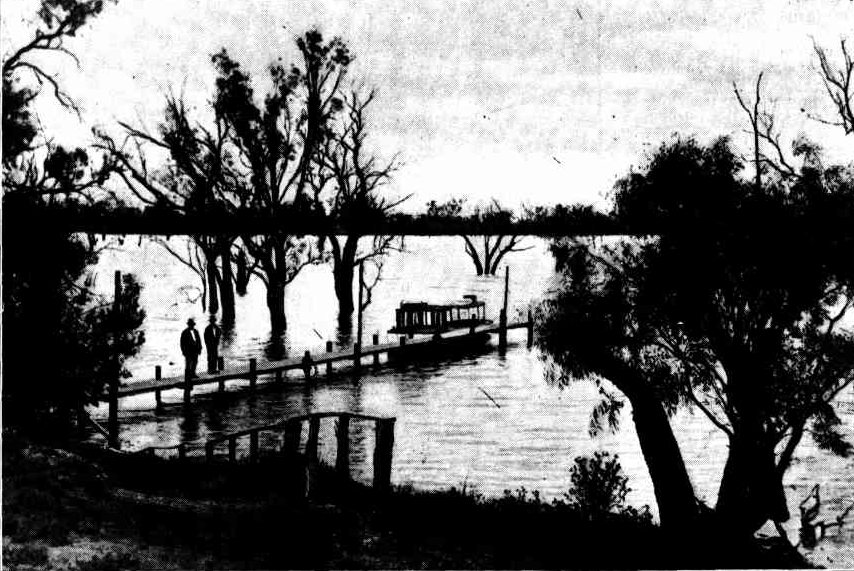
Two lads out in a rowing skiff spotted the corpse floating near Crusoe Island. With no way of pulling it aboard, they tied a cord around the sockless ankles and towed it back to the jetty behind their little craft, taking it in turns to row.
Word spread of the boys and their grisly find, and a crowd gathered on the lake shore. Will Jones was amongst them, for he had hurried down with most of the drinkers in the public bar of Jackson’s Hotel.
The body, when it came to the jetty, was dressed in loose trousers and a red Crimea shirt, the usual style of garb for a morning sailing expedition. Its skin, viewed in the light of day, was pale blue, eyes open and staring. The gorge rose in Will’s throat at the sight.
Two policemen were in attendance. One was the scarred constable, and the other, to Will’s surprise, was the posturing sergeant he and Clarkie had met on the road out west, more than a week earlier.
The traps carried the corpse from the water’s edge to a wagon. Even as they laid it carefully on the buckboards, a handsome but tear-streaked woman ran up and laid her head on the body, hair spilling over its chest and face.
‘Me darlin’ Cyril!’ she cried. ‘Oh pity. Dear Lord take pity on me.’
A handful of supporters, including a reverend dressed in black, stepped from the crowd to offer her, and the brace of infants who accompanied her, comfort.
A doctor arrived, put down his black leather bag of instruments, peeled back each of the dead man’s eyes, and checked the time on a pocket watch. He lifted each hand in turn, and examined the fingernails.
‘No obvious signs of a struggle,’ he said aloud. ‘But I will examine him thoroughly back in my surgery.’
As the driver flicked the reins, and the wagon rolled away, the doctor and the police sergeant walked beside it like footmen from Hell. The dead man’s widow, and her offspring, followed behind.
The constable who had spoken to Will the day before, his moustache uncombed and unruly, the rest of his face bearing a morning stubble, fell in beside him.
‘William Jones, I must ask you to accompany me to the police station.’
Will felt a jolt, ‘And why would that be?’
‘You’ll soon learn, so come along quietly, and don’t make a scene.’
When Will walked away from the lake-side crowd, in the company of the trap, he heard soft whispers and felt hard eyes bore into his back. His conscience was clear. He had done nothing wrong, but still the heat of the sun beat more fiercely down, and there was a tremor in his limbs that he could not seem to still.
The constable hooked his hand through Will’s arm, but the innocent man shrugged it aside. He would not, he told himself, be treated as a criminal.
They walked up Foster Street, turning into Canada Street, past the courthouse to where the police station stood – a weatherboard place with a veranda, and brick chimney on the southern side. A broken wagon wheel lay against one of the veranda posts.
The constable opened the door and led the way into the oven-like interior. He sat Will down in the front room. By then the sergeant came through the door, hung his hat on the rack and took a seat. He planted one arm flat on the table and spoke. ‘I had a feeling that we would meet again, Will Jones. I study men’s faces like a farmer studies clouds. He looks for rain and I look for trouble. I am seldom wrong on that score.’
The constable fetched a document from a desk drawer across the room, then unfolded it on the table. ‘We found this on board the um, deceased man’s boat,’ he said. ‘It was sitting on the table in the cabin.’
The sergeant picked up the paper and cleared his throat, ‘It says, “I, Cyril Achilles Lowe, of Lorne Street Cargelligo, of my own free will hereby transfer ownership of Gold Lease 3571 in the Parish of Sofala, County of Roxburgh, to Mr William Jones of no fixed address, free of any encumbrance.” As you can see, the note is signed, and Mr Lowe’s solicitor has confirmed it as his.’
Will narrowed his eyes, exhaling through his nose, trying to make sense of what he had just heard. He remembered Cyril Lowe talking about the lease, how it was a good bet for alluvial gold, and that he would be happy to take a hundred pounds for it.
‘Can you enlighten us as to why this lease might have been made over to you?’ the sergeant asked.
Will shrugged, ‘We yarned about that lease with Mr Lowe, in the public bar … the night before he um, must have got drowned.’
The sergeant looked at the constable, long and significantly, then turned back to Will, ‘How well do you know John Clarke?’
‘We been on the road as mates for a month or two,’ Will said.
‘When I met you last, John Clarke told me that you’d been working together for more than six months. Is that not true?’
Will shrugged again. It was no point lying. Station registers could be seconded. The traps would get to the truth in the end. ‘Nah, we only actually worked in the same crew fer a week or two, well-sinkin’. It were terrible hard yakka and we both got jack of it.’
‘Well,’ said the sergeant, ‘I’m almost certain that John Clarke was one of the three lags who robbed the Oxley mail coach a while back. That suggests to me that he might also be involved in the death of Cyril Lowe.’ The sergeant reached in his top pocket for his pipe, rolled a pinch between his fingers, packed the bowl and lit it. ‘As for you, I’m not so certain. You’re either an imbecile, or a villain, and I intend to find out which. If the body of John Clarke is also in the lake, we will find it. If not, we will hunt him down, for there is only one conclusion we can draw. In the meantime, you must not leave your hotel.’
Will, who was already thinking that leaving town might be his best move, said, ‘I’ve done nothing wrong. I can’t afford to pay lodgings for days on end.’
‘Then camp on the lake shore, but do not leave town or I will ride after you myself, and bring you back in chains.’
‘For what crime?’
‘Mark my words son, a man is only as honourable as the company he keeps. I’m not the only one who suspects that your mate John Clarke is a murderer, and you may yet prove to be an accessory to that crime.’
‘Can I go now?’ asked Will.
The sergeant took a slow puff of his pipe then let a twin stream of smoke flow from his nostrils. ‘For the moment, yes.’
Will was thinking deeply as he walked back to the hotel. His overriding emotion was anger, mostly directed at Clarkie, who had put him in this position.
He decided that it was time to make some enquiries of his own.
First, he went to the stables where the two stable boys were forking hay from a stack into a handcart. He passed them by and leaned on a rail, watching the horses belonging to the hotel guests waiting for the coming feed.
His mare, Nea, trotted closer, staring at Will with those fierce brown eyes. He coaxed her closer and stroked her head – still the only affection she would suffer – until the stable boys brought up the hay. At that point she hurried across to claim her share.
Now, Will counted the horses that had belonged to he and Clarkie. All of the packs and spares were accounted for – five in number. Yet, the big grey gelding, Clarkie’s favourite mount, was nowhere to be seen.
‘You right there mate?’ yelled one of the stable boys.
‘Just sayin’ hello,’ said Will cheerfully.
While the workers were busy with the hay, Will wandered into the tack room. His own saddle – the beautiful poley he had won, years earlier – sat on the rack. Clarkie’s saddle was also there, along with an older spare. Will, however, looked on the other side of the shed, where a tangle of old harness and abandoned saddles sat askew, on an overburdened rail, where they had been left by hotel owners, their family, or forgotten by careless guests. It seemed to Will that anyone who wanted to steal a well-used but workable saddle, could take one.
Heading back upstairs, Will looked again at the pile of gear at the foot of Clarkie’s bed. He kneeled and sorted through it. The Colt revolver was gone. His leather purse of coins was gone, along with his pipe and tobacco pouch. That didn’t mean much on its own, Clark took his firearm and money on his person almost everywhere, but together with the missing horse it was interesting.
Will sat down on the bed, the world swirling around him. He felt very alone, and a little scared. He’d hardly slept the previous night, and after a short time he lay on his side and fell asleep.
New chapter soon
© Greg Barron 2026
Read past chapters https://storiesofoz.com/category/the-adventures-of-will-jones/
More stories and books available at https://ozbookstore.com/
Image Credit: Lake Cargelligo – Trove


We’d love to hear your thoughts on this post!