
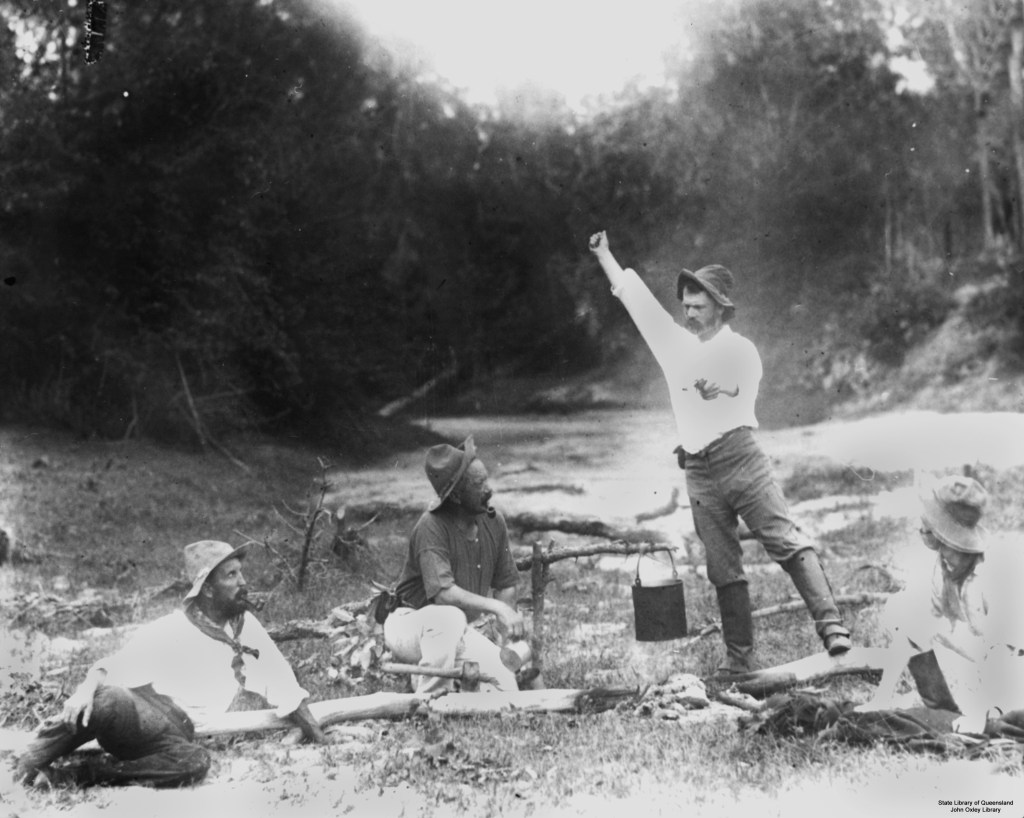
The Adventures of Will Jones by Greg Barron
The sun was a yellow ball, almost touching the western horizon, when twenty-year-old Will Jones walked his mare over the dusty rise in the shimmering heat. Beside him rode an older man, thickset and assured in the saddle, and obviously shorter in stature though he was mounted.
Behind the pair trailed three packhorses, and two spares, heads down and plodding, keeping pace only because of the pressure of the lead rope.
Will was lean in his features, his skin burnished red-brown from the sun. He wore a beard, of the same fair colour as his hair, clipped raggedly short. Five years had passed, since the family farm was sold, his parents sailed for England, and Lainey moved with her new husband Luke to one of his family’s properties near Baradine. For most of that time, Will had lived the life of a stockman.
He’d done time as a rouseabout, a few stints on the long paddock, and the last three years at Kinchega Station near Menindee, living in stock camps and mustering along the winding Darling River. He’d mastered the game of mumble the peg and could plait greenhide with the best of them. He’d roasted bush ‘oysters’ on the coals and called them delicious, and near perished on one long hot day far from water. He’d tried his luck on every kind of buckjumper and ridden bulls to prove his courage. He’d made mistakes, been congratulated and ridiculed, sometimes both on the same day.
More than once, he’d jockeyed his own mare at a bush race meeting to the winner’s post. Now called Nea, she had once been referred to as the Black-Hearted Filly, and was still the best and fastest horse he had ridden. Still prone to a buck when fresh, she was, however, tireless and quick, seeming to enjoy a muster or race as much as he did.
Will was hardened, but still energetic. He had proved to be a clever stockman, but the bosses and their demands, that worried him little at first, soon made him realise that other men were growing rich at his expense. It seemed to Will that there were opportunities, out there somewhere, and it was time to investigate.
Taking his cheque, he’d ridden west to the South Australian border, over the Barrier Ranges, ‘just to see how far it was.’
On the way back, he’d taken work with a well-sinking crew, and that’s where he met John Clark – Clarkie. Older, more experienced – worldly – but with a mischievous mind and a bottomless store of yarns.
The pair, falling in as mates, heard talk of a new goldfield near a town called Lake Cargelligo. Clarkie reckoned he knew a secret way of winning alluvial gold that only the experts know. So, they were now riding east, with that vague plan in mind.
Will reined in for a moment, ‘Look ahead. I reckon I can see the crossroads, and the government trough.’
‘You’re right, old son,’ said Clarkie, ‘that’s a trough indeed, an’ just in time for a swig of rum an’ some tucker.’
There was no stopping the horses now, for they had the smell of water in their nostrils, and they tumbled up towards the trough beside the well, in a dusty clearing at the intersection of two tracks. A signpost had been erected, pointing north, south, east and west, with the crudely lettered words Cobar, Griffith, Condoblin and Ivanhoe in each branch respectively.
The water level in the trough was low. Will dismounted and began to work the hand pump, filling his nostrils with the smell of water, albeit tinged with minerals and earth.
Sated, at last, the horses were unloaded and untacked, then hobbled and the lead-mare belled. There was scant feed around the bore, but Will took the little hatchet, cut branches from a couple of nearby mulga trees and laid them on the ground. It was poor feed for horses, and only the green leaves were edible, but even the saltbush and tussock had been grazed out from around the bore.
Gathering sticks, Will and Clarkie made a small fire. Tobacco pouches and pipes appeared in their hands. They smoked and talked for a while, sitting on their rolled swags near the fire.
The last of their mutton was spoiled, but Will trimmed the worst of the putrefaction with his pen knife, cut it into strips and fried it to char. They ate it with johnny cakes they had baked on the road.
They were men who lived around firesides. And it was one of the pleasures of their lifestyle to feel the warmth of flames against the evening chill. They had just settled down after the meal, with a mug of rum; Clarkie launching into a yarn, when they heard thundering hooves – riders coming up from the south.
Will stood up, and in the last glow of daylight he saw at least five men, all mounted, trailing twice that many spares and packs.
Clarkie drew his pistol, and Will grabbed his Snyder rifle, then fumbled in his saddlebag for a cartridge. No chances were taken with armed parties arriving in the near-dark.
The two men stood together, watching the riders come, kicking up a dust cloud in their wake.
‘They’re traps,’ Clarkie spat. ‘Gawd in ‘eaven knows what they want out here.’ His voice sounded thin and nervous.
Will felt the same way. Police parties were rarely welcome. ‘They’ve got a prisoner, look?’
It was true, a man with a filthy shirt that had once been red, was hunched over his saddle, both hands cuffed so he could hold his own reins and his horse roped to the sergeant who rode ahead of him.
The mounted party came up fast, now recognisable as two NCOs and the same number of armed troopers. The leader was a sergeant, moustached and parade-ground straight. ‘Stand back you men,’ he called out, addressing Will and Clarkie as he approached, ‘and put down those weapons.’ He dismounted and shouted at one of the troopers to take his horse.
Will leaned his rifle against his swag, and Clarkie holstered his pistol. Disarmed now, they watched the prisoner as the gelding he was on took a long drink, the sweat still shining on his flanks.
Up close it was obvious that the prisoner had been thoroughly beaten, either by the traps or persons unknown. His face was marked with long streaks of dried blood, and it was a miracle that he could see out of his swollen eyes.
He was also raving, making sounds and observations, about the bore, the police, the dust and the sky. After a moment or two, however, he turned and looked straight into the eyes of Clarkie. At that point he became animated. ‘Oi, there, you double crossin’ cur.’ He did his best to point with his bound hands. ‘You traps best arrest that man there, before ‘e steals the very air that youse breathe.’
The sergeant strode over to the fireside, moustache quivering, staring at Clarkie. ‘Do you know the prisoner?’
‘Me, sir? Never seen ‘im before in my life,’ drawled Clarkie. ‘Seems like a lunatic, by any measure of the condition.’
‘Youse should arrest that man,’ wailed the prisoner. ‘Why don’t you mongrels arrest him?’
‘What were the poor cow’s crime?’ asked Will.
The trap answered Will, but kept looking at Clarkie. ‘He’s one of three men who tried to rob the mail coach down the Lachlan. We chased them all the way out to Booligal. One we shot dead and we’re still lookin’ for the other lag.’
‘News to us,’ said Clarkie. ‘Me an’ Will has been together for a year or two, workin’ as stockmen, then lately a well-sinkin’ crew for Paulie Cray at Stirling Vale. Never heard nothin’ about it.’
‘So,’ said the sergeant. ‘Do I have your word that you don’t know the prisoner?’
‘Never laid eyes on ‘im,’ Clarkie affirmed.
The sergeant made a noise in his throat. ‘Then what’s your business on the road?’
Clarkie raised a bushy eyebrow. ‘Why, we’re travellin’, mister sergeant sir. After a long stint of hard work. I don’t see that’s any business of yours.’
‘Everything’s my business,’ said the sergeant, then inclined his head at the horses that were grazing nearby. ‘Are the brands on all them neddies yours?’
‘Well, the brands might not be ours, but they be bought and paid for,’ said Clarkie.
The troopers were still busy around the trough, leading horses in and letting them drink. Two mounts had a disagreement, and there was a kick and a neigh.
The sergeant turned to look for a moment, then stepped closer to Will. ‘What about you? You ain’t saying much.’
Will shrugged, ‘Just headin’ east,’ he said. ‘That aren’t a crime so far as I know.’
The sergeant pointed to a pile of chop bones, picked clean, sitting near the fire. ‘And I s’pose that sheep belonged to you also?’
Clarkie said, ‘The meat was given to us by the cook at, where was it … Conoble I recollect … two days back.’
The sergeant made a huffing noise, then said, ‘Very well. We’ll bivouac over the track for the night. We’ll be up at first light, and if I have a minute I plan to have a look at the brands on your mounts.’
With these words he strolled over past the trough, and across the track. He supervised the placement of a tent, where presumably the two white officers would sleep. The troopers threw their swags down, pitched the tent and lit a fire. The prisoner was handcuffed to a mulga trunk, still raving and calling out.
Will released his breath in one long sigh, and was surprised that he had been holding it. He and Clarkie headed back to their places near the fire, which had burned down a little.
When they had added a few more sticks, and were settled, Will said to Clarkie. ‘Why’d you tell the trap that we’d been together for years?’
‘Dunno,’ said Clarkie. ‘Don’t want to tell those bastards anything straight.’ He looked up at the sky, and said, ‘There’ll be a good half-moon rise in a couple of hours. D’ya mind if we saddle up and ride on then?’
‘No bother to me,’ said Will, though it seemed like a strange thing to want to do.
New chapter soon
© Greg Barron 2026
Read past chapters here.
More stories and books available at the Stories of Oz Bookstore
Image Credit: Bushmen boiling the billy at a camp site near the river, State Library of Queensland


We’d love to hear your thoughts on this post!