• Where the Dead Men Lie

    Barcroft Boake
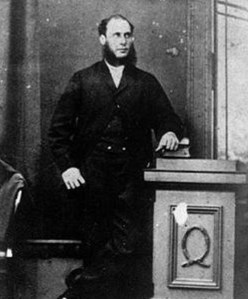
    Barcroft Boake in 1892. State Library of Victoria

    There have always been two schools of thought on the Australian bush: epitomised in the romantic writings of Banjo Patterson, and the harder, more brutal outback of Henry Lawson.

    The poet who presented the bush in the harshest light of all was stockman and poet Barcroft Boake. That doesn’t, of course, mean that he loved it any less. Born in Balmain, in 1866, Barcroft was the son of a very early professional photographer. Having lost three of his siblings in their infancy, he was prone to bouts of melancholy, even as a child, but he loved sport and outdoor activities. He dreamed of living and working in the outback.

    At the age of seventeen Barcroft applied for training as a surveyor. He spent years in the back blocks of New South Wales, connecting with the Western landscape. Before long he had quit the Survey Department and was off droving in Queensland. At the same time he devoured the poetry of Adam Lindsay Gordon, and developed the urge to express the tough love he felt for the bush. He started writing, and by 1890 his poems were appearing regularly in the Bulletin magazine.

    His career as a poet was short-lived. When he was just twenty-four years of age he was called back to Sydney where his family was facing bankruptcy. Barcroft helped with what he could, but fruitlessly searched for work, battling depression and anxiety. His body was found under a tree on the shores of Sydney Harbour in May 1892, hanging from his own stockwhip.


    Where the Dead Men Lie
    By Barcroft Boake
    
    
    Out on the wastes of the Never Never -
    That's where the dead men lie!
    There where the heat-waves dance forever -
    That's where the dead men lie!
    That's where the Earth's loved sons are keeping
    Endless tryst: not the west wind sweeping
    Feverish pinions can wake their sleeping -
    Out where the dead men lie!
    
    Where brown Summer and Death have mated -
    That's where the dead men lie!
    Loving with fiery lust unsated -
    That's where the dead men lie!
    Out where the grinning skulls bleach whitely
    Under the saltbush sparkling brightly;
    Out where the wild dogs chorus nightly -
    That's where the dead men lie!
    
    Deep in the yellow, flowing river -
    That's where the dead men lie!
    Under the banks where the shadows quiver -
    That's where the dead men he!
    Where the platypus twists and doubles,
    Leaving a train of tiny bubbles.
    Rid at last of their earthly troubles -
    That's where the dead men lie!
    
    East and backward pale faces turning -
    That's how the dead men lie!
    Gaunt arms stretched with a voiceless yearning -
    That's how the dead men lie!
    Oft in the fragrant hush of nooning
    Hearing again their mother's crooning,
    Wrapt for aye in a dreamful swooning -
    That's how the dead men lie!
    
    Only the hand of Night can free them -
    That's when the dead men fly!
    Only the frightened cattle see them -
    See the dead men go by!
    Cloven hoofs beating out one measure,
    Bidding the stockmen know no leisure -
    That's when the dead men take their pleasure!
    That's when the dead men fly!
    
    Ask, too, the never-sleeping drover:
    He sees the dead pass by;
    Hearing them call to their friends - the plover,
    Hearing the dead men cry;
    Seeing their faces stealing, stealing,
    Hearing their laughter, pealing, pealing,
    Watching their grey forms wheeling, wheeling
    Round where the cattle lie!
    
    Strangled by thirst and fierce privation -
    That's how the dead men die!
    Out on Moneygrub's farthest station -
    That's how the dead men die!
    Hard-faced greybeards, youngsters callow;
    Some mounds cared for, some left fallow;
    Some deep down, yet others shallow.
    Some having but the sky.
    
    Moneygrub, as he sips his claret,
    Looks with complacent eye
    Down at his watch-chain, eighteen carat -
    There, in his club, hard by:
    Recks not that every link is stamped with
    Names of the men whose limbs are cramped with
    Too long lying in grave-mould, cramped with
    Death where the dead men lie.


    RIP Barcroft Boake

     This is an excerpt from Galloping Jones and other True Stories from Australia’s History by Greg Barron. Available at ozbookstore.com
  • Lost

    FREDERICK MCCUBBIN LOST
    Lost, by Frederick McCubbin.

    It was May 1885, and twelve-year-old Clara Crosby was boarding with a local family at Yellingbo, Victoria, when she decided to visit her mother, who lived some two kilometres away.

    Setting off across paddocks and bushland, Clara was seen by several locals, including the publican, as she left town. She failed to reach her destination.

    By nightfall the police had been alerted. Troopers, blacktrackers and local bushmen combined to comb the area, but heavy rain obliterated any tracks. After days of intensive searching the party dispersed, and it was assumed that Clara had died in the heavy scrub that surrounded the town.

    Days of grieving passed by, and slowly the little town began to recover from what seemed like a senseless tragedy. Then, three full weeks after Clara had first wandered off, two road workers were looking for a horse in thick scrub far from the town, when they heard a human-like cry.

    In the hollow trunk of a dead tree they found a starving, naked girl, streaked with lacerations and so weak she could not stand. Clara sobbed with relief as they wrapped her in their jackets and took her back to their camp for food and warmth. By nightfall she was recovering at the Woori Yallock Hotel, with her mother in attendance. Within days she was being hailed across the country as a miracle.

    Clara had taken a wrong turn and walked blindly into the scrub. She had lost her clothes trying to cross the near-freezing waters of Cockatoo Creek, and kept herself alive on water and leaves, hanging her petticoat over the opening of her hollow tree to keep the warmth in.

    Later, a Melbourne waxworks induced Clara to recount her story for a fee, and over time, some 150 000 people paid money to hear her story. Later she was married, unfortunately into an abusive relationship.

    Well known painter, Frederick McCubbin heard the story in 1886. He was, at the time, in one of his “bush camps” in company with other artists like Arthur Streeton and Charles Conder at a farm near Box Hill. His painting Lost (main image) was based on Clara’s experiences, and was followed a few years later by a companion piece, called Found.


    Researched and written by Greg Barron.

    Click here to view the sources for the story.

    This is an excerpt from Galloping Jones and other True Stories from Australia’s History by Greg Barron. Available at ozbookstore.com

  • James “Shearblade” Martin

    James Martin - Queensland Police Museum

    James Martin was working as a boundary rider when he first got his hands on a copy of Karl Marx’s Communist Manifesto.  He was thunderstruck by the possibilities. He carried the book everywhere while he absorbed every word. He then moved on to other socialist writers such as Bellamy and Nordeau.

    A dream was born, to make Australia a worker’s republic, owned by the people.

    In 1891, while shearing shed after shearing shed was burned to the ground by rampaging shearers, Martin hurried from town to town, enlisting recruits and trying to convince strike breakers to change sides. In Barcaldine he addressed a crowd where he announced that it was time to move against the Queen, who he referred to as “Old Mother Brown.”

    “What we want is a revolution and a republic,” he said. “If the amalgamated miners are prepared to back us, we are prepared to take the colony. I have a petition in my swag for electoral reform, but the only petition I believe in is 10,000 resolute bushmen behind 10,000 shear blades.” His numbers were not inflated. 8000 strikers were living in at least forty camps across Queensland, and thousands more were living independently or at home.

    Almost as furious about Martin’s disrespect to the Queen as his threat to conquer Queensland, a team of policemen were soon on the trail of the man now known as James “Shearblade” Martin. On the day of his arrest he was carrying a revolver and seventy cartridges. This fact did not impress the judge. He was sentenced to two years in prison for sedition, and taken to the dreaded St Helena Island, off the mouth of the Brisbane River. Known variously as “the hell hole of the Pacific” and “Queensland’s Inferno,” Martin served two years in that gaol, suffering mercilessly under the lash and terrible conditions.

    Released at the end of his sentence, Martin turned up in Charleville, taking control of the Australian Workers Union there, just in time for the next round of the Shearer’s Wars in 1894. He marched a small army to Winton, where the strike action was centred. Terrorising and converting scab labour was the number one activity, and Martin was involved in the burning of at least three woolsheds.

    This was harsh, but bear in mind that the pastoralists had again banded together to set shearers’ pay below what was considered a living wage. These men were fighting for the right of their families to eat.

    For the burning of the Ayrshire Downs woolshed Martin was ultimately charged with arson and sentenced to fifteen years at hard labour. They transported him on a steamer, padlocked to his bunk, to Townsville’s Stewart Creek Gaol, where he was placed in solitary confinement, in tropical heat, for three months. Later that year he was taken back to Brisbane’s Boggo Road, and ultimately to his old prison at Saint Helena Island, where he worked, for a time, as librarian, bootmaker, and cook.

    Petitioned for early release, by members of the original jury, and 1500 members of the public, Martin and his co-accused served only four and a half years.

    That was the end of James Martin’s dreams of a workers’ state in Australia. After his release he went to join the revolution in Paraguay, where his side had much better success than they did in Australia.


    Researched and written by Greg Barron.

    Click here to view the sources for the story.

    This is an excerpt from Galloping Jones and other True Stories from Australia’s History by Greg Barron. Available at ozbookstore.com

  • The Battle of the Margaret River


    In 1880, Australia’s borders were open, with no quarantine restrictions, and few immigration controls. Chinese miners had been flooding into the Territory goldfields for years. The Margaret River goldfields, north of Pine Creek, were worked by two rival Chinese factions, one from Hong Kong and the other, Macao. When they weren’t attacking each other with muzzle-loaders and shovels, they united against the Australian miners.

    In late August, 1880, a young digger by the name of Fred Stone asked a storekeeper called Ah See to look after a bag of his wash-dirt overnight to save him carrying it back to his claim. For some reason the request enraged the Chinese man, who responded by pushing the Australian out onto the track.

    Punches were thrown, and the furious storekeeper shouted for help from his countrymen, who came running from all directions. Picking up stones, they pelted Fred from all sides until he broke and ran. His Australian comrades, up at the camp, were greeted with the sight of their mate running flat out towards them, pursued by a mob of two hundred rock-throwing Chinese.

    What choice did the white diggers have? Filling their own pockets with rocks they rushed to their mate’s defence, pouring a highly accurate barrage of missiles down on the Chinese. Meanwhile, the only policeman within cooee, Constable Lucanus, ran back and forth trying to quell the riot. He eventually succeeded, but not before he too had been peppered with rocks in the body and legs.

    An eyewitness to the fight, a reporter from the Northern Territory Times and Gazette wrote:

    “Some of the incidents of the battle were amusing. One powerful young European came to the front and intended to throw stones in return, but he became a splendid object for the enemy; and instead of throwing, he found himself sufficiently occupied in avoiding the missiles. He admitted himself (that) it was a most unsatisfactory method of fighting.”

    The smallest white man there was apparently the best rock chucker, being described as a human Gatling Gun, causing carnage amongst the “enemy.” Not every man was armed with rocks: two diggers with rifles, and a local Aboriginal man called Billy Muck with his tomahawk, stood by, watching in case things got out of hand.

    In the end, five of the most violent of the Chinese were arrested, taken to the “shackle” and tried for affray. Within a few years the area was mainly worked out and abandoned. Interestingly, a portion of the Margaret River goldfields has recently been designated as a public fossicking area.

    Researched and written by Greg Barron.

    Click here to view the sources for the story.

    This is an excerpt from Galloping Jones and other True Stories from Australia’s History by Greg Barron. Available at ozbookstore.com

  • Captain Moonlite

    Capture_of_moonlite Vic state library
    Capture of Moonlite: Victorian State Library

    It was Saturday, November 15, 1879, and the McDonald family, at Wantabadgery Station, half way between Wagga Wagga and Gundagai, were settling down for the evening. A shepherd galloped in from further down the Murrumbidgee with the news.

    “I seen a gang of horsemen coming up along the river,” he said breathlessly. “I swear it’s Captain Moonlite and his men.”

    While family and employees alike took refuge inside the house, seven horsemen rode out of the night. A pounding on the door followed. Claude McDonald, the station owner, opened the door a crack, revealing Captain Moonlite himself, dressed in a dark cloak, as dashing as his reputation.

    “Good evening,” the bushranger said in his cultured Irish accent. “My men and I are starving. Can we trouble you for bread and tea?”

    “Ride off, and don’t come back,” came the answer. Furious, Moonlight stalked back to his men and horses. The gang members loaded their revolvers and Snider rifles. Gunfire was exchanged, and within a few minutes, Moonlite had taken control of the homestead. The gang rounded up the neighbours, twenty-five in all, and raided the Australian Arms Hotel, a mile or two down the Gundagai Road, taking all the liquor they could carry.

    Moonlite and his men ate and drank into the night. To entertain themselves they forced young women to play the piano or sing, and held a mock trial of a man who tried to escape. One brave stockman attempted to charge the guns, but was knocked down and restrained.

    Four troopers, arriving on the scene, had little chance of taking down the well-armed gang, who fired at them through the windows. Riding off for reinforcements, however, the troopers were soon back with five more men from Wagga Wagga. The policemen surrounded the homestead, and the Moonlite gang, seeing the odds against them, slipped out by a side door.

    Fighting a rear-guard action, firing from outbuildings and neighbouring farms, Moonlite and his men finally found themselves penned in to an outdoor kitchen. Gus Wreneckie, just fifteen years old and by far the youngest member of the gang, was shot and killed. There was no turning back now. A bullet from Moonlite struck home, killing Constable Edward Webb-Bowen.

    Captain Moonlite’s right-hand-man, James Nesbitt fell also, shot dead, and this was a bitter moment for Moonlite. He fell to his knees, cradling his dying mate in his arms. Constable McGlede saw his opportunity, charging the kitchen, disarming the leader and scattering the gang. It was all over.

    Only Moonlite himself, and a man called Tom Rogan, felt the hangman’s noose, the other three survivors were given long prison sentences. The legend that grew up around Moonlite’s life kept the public interested for years, and the facts slowly faded from memory.

    Captain Moonlite, whose real name was Andrew George Scott, was surely Australia’s strangest bushranger. The Irish-born engineer, soldier and lay-preacher, though violent at times, was more of a talker than a fighter, and had an inflated opinion of his own worth. He had a history of swindling friends and opportunistic robbery. The cape was just part of his penchant for dressing up.

    His first major heist involved robbing gold bullion from one of his best friends, then leaving a note claiming the robbery in the name of ‘Captain Moonlite.’ He later caused a mass break out at Ballarat gaol by tunnelling through a wall and into neighbouring cells. After years of trouble with the law, and a second stint in prison, he formed a gang with six other slum dwellers and ex-cons and headed for the bush.

    The police and public took Moonlite seriously, but other bushrangers and the hard men of Australia’s countryside did not. Legend has it that when operating in Northern Victoria, Moonlite sent a message to Ned Kelly and his gang, suggesting that they join forces. The answer apparently came back from Ned that if Moonlite or his men came anywhere near him he’d shoot them down like dogs.

    Much has been made of Scott’s relationship with Nesbitt. There’s no doubt that they were unusually close. Was Captain Moonlite, with his love of the theatrical, and deep feelings for his friend Nesbitt, Australia’s only gay bushranger? We’ll never know for sure, but we do know that Nesbitt’s death broke his heart.

    “My dying wish is to be buried beside my beloved James Nesbitt,” Scott wrote before his hanging, “… the man with whom I was united by every tie which could bind human friendship. We were one in hopes, in heart and soul and this unity lasted until he died in my arms.”


    Note: A plaque commemorating the Siege of Wantabadgery hangs on the wall of Gundagai’s Criterion Hotel.

    Researched and written by Greg Barron.

    Click here to view the sources for the story.

    This is an excerpt from Galloping Jones and other True Stories from Australia’s History by Greg Barron. Available at ozbookstore.com


  • Collateral Damage

    Glenrowan
    The Glenrowan Inn. Credit: Victorian State Library

    Spare a thought for the Jones family, who owned the Glenrowan Hotel when the Kelly Gang decided to use it as the venue for a battle with police.

    Ann Jones was the owner and publican. In the battle her pride and joy was burned to the ground. Her son John was shot and killed in the crossfire. Her daughter Jane also caught a stray bullet, but lingered on for two years before dying from her wounds.

    Documents found at the Supreme Court stated, in Ann’s own words:

    “Brave police! They lay in the gullies, and behind the trees, and shot bullets at the house, knowing that it was full of people. My poor innocent little children suffered most. When my dead little boy was hit he stood up, looked around, and then fell down. ‘Oh God,’ he cried, in such a piteous voice. ‘Mother, dear mother, I’m shot!’”

    After the siege, the distraught Ann screamed abuse at the police, and was arrested for being a Kelly sympathiser.

    “The police have said things about my character,” she said later. “Most of them never had any.”


    Written and researched by Greg Barron

    Click here to view the sources for this article.

     This is an excerpt from Galloping Jones and other True Stories from Australia’s History by Greg Barron. Available at ozbookstore.com


  • As Brave as a Bushranger


    KateKelly_slv_mp004324

    No one knew young Ada Foster when she arrived in the Forbes, New South Wales district in 1886. She was just twenty-three years old, but was attractive and hardworking, and had no trouble finding a position.

    Working as a domestic at Cadow Station, she was soon showing off her talents as a horsewoman. An expert horse breaker and rough rider, she spent every spare minute at the yards, and few of the station workers could best her on a horse. A visiting stockman claimed to have seen her trick riding for a Wild West show in Sydney, and this led to questions about her past.

    Ada moved on, taking on a position with the Prow family, then a butcher called Gunn. At one stage she even worked as a home helper with the town’s undertakers.

    Despite whispers that she was hiding a secret, it wasn’t long before Ada was being pursued by a bunch of suitors, and she chose William ‘Bricky’ Foster, a blacksmith and horse trainer. The pair were married in November 1888, and things went well for a while.

    Unwilling to be a genteel housewife, Ada spent her time breaking horses and riding. The first two children, Frederick and Gertrude, were born healthy, but three of their next four children died in infancy. It was the death of little Catherine in 1898 that sent Ada over the edge. She was diagnosed with ‘milk fever’, as post-natal-depression was called in those days, and things went bad. Bricky was away most of the time, blacksmithing or training horses in distant towns.

    Ada found solace in the bottle, and the townspeople turned on her. A lost and tragic figure, she was hounded by rumours of her youth and memories of the destruction of her family.

    Ada’s real name was Kate – Catherine Ada Kelly – the sister of Australia’s most infamous outlaw, Ned Kelly. It was she who had fought hardest to save Ned’s life, even going down on her knees to the Victorian Governor to plead that he be spared the rope.

    After Ned’s death, Kate found it impossible to live, unmolested, under her real name. She took her middle name, Ada, then left home and travelled, looking for a new life. After a few months with Lance Skuthorpe’s travelling Wild West show, performing as a trick rider, Kate ended up in Forbes.

    Now, the loss of three children, along with memories of her brother Dan’s burned body, and Joe Byrne’s corpse hanging from the door of the Benalla Lock-up, sent her to the edge. What happened next is folklore, not solid fact, but if there’s a grain of truth in this tale, Kate Kelly deserves far more adulation than that piled on her brother Ned.

    Ravaged by alcohol and depression, one day Kate was walking by the Forbes Lagoon, opposite the racecourse, when she saw a local Aboriginal child out of his depth and in trouble. Despite being burdened by the heavy dresses of the day, she did not hesitate, charging through the water to save him.

    After delivering the child safely to the bank, Kate was not seen alive again. Eight days later, they found her body floating face down in the water. Her brother Jim Kelly hitched up his wagon and drove all the way from Victoria to fetch Kate’s three children and take them home to live with their Grandmother, Ellen. Bricky wanted to raise them, but the Kellies insisted. And another page turned in the history of the troubled, wild, but undoubtedly talented Kelly family.

    Written and researched by Greg Barron

    Click here to view the sources page.

    This is an excerpt from Galloping Jones and other True Stories from Australia’s History by Greg Barron. Available at ozbookstore.com

  • The JC

    In the late 1860s pastoralist and adventurer John Costello rode west from his holdings on Kyabra Creek, exploring the Channel Country out to the Diamantina. One night he camped beside a small creek, where he stripped back the bark of a bauhinia tree and carved his initials, JC.

    That tree became a popular stopping place for travellers, and when an enterprising hotelier built a mud-brick pub on the site, he called it the JC Hotel. The government surveyor was sent in to lay out a town, but he refused to call the new town JC because it wasn’t proper. He named the place Canterbury instead, but to locals the name never changed.

    In the mid-1880s the pub was being run by two men in partnership: Manners and Dalton. Not only did they spruce the place up, but apparently Mrs Dalton was a popular figure behind the bar. A visitor in 1885 reported that nearly thirty men sat down to eat breakfast at the hotel.

    The owner of nearby Waverney Station, a man by the name of Gibbs, built a store next to the pub. It was apparently “fully stocked with all the requirements of a country store.” A post office was opened in 1891, and ran for a couple of years before being downgraded to a receiving office.

    In 1893 the pub was being run by George and Elizabeth Geiger. Their son, also named George, was not quite two and a half, playing in the yard when he wandered off. One story goes that he had a pet lamb, and when it was taken by a dingo, he followed.

    Every available adult, including some capable trackers, were enlisted to find young George, but the flock of goats kept by the family had obliterated his tracks, and the mulga scrub made it hard to see more than a few yards. They found him in the end, much too late, and the dingos had finished him off. His grave still stands in the small cemetery there.

    The pub was the venue for regular dances, and an annual race meeting. Most importantly it gave travellers a friendly place to stop between Windorah and Bedourie. The beer flowed for another half century before the manager of Waverney bought it for a pittance and shut it down. He was sick of his stockmen spending their free time there and riding home drunk.

    Story, research and photographs by Greg Barron. This is an excerpt from Galloping Jones and other True Stories from Australia’s History by Greg Barron. Available at ozbookstore.com

  • Paddy Cahill

    Cahill

    Paddy Cahill: State Library of South Australia


    Originally from the Darling Downs, Paddy Cahill made his name in the Northern Territory as a bushman, stockman and buffalo hunter.

    Paddy and his two brothers, Tom and Matt, all cut their teeth with the famous Nat Buchanan on one of Australia’s biggest cattle drives, from St George in Queensland to Glencoe Station in the Northern Territory. All three stayed on in the frontier country, Paddy forming Oenpelli Station on the East Alligator River, where he produced beef and even milk from a small dairy herd.

    Within a few years, with a burgeoning market for hides, Paddy started buffalo hunting. This was a risky undertaking, pursued in wetlands frequented by huge crocs. The ground was treacherous for horses, and therefore the key to the business was a good supply of surefooted mounts, and a skilful team. Paddy’s horse St Lawrence was a legend in the north, and one of the reasons for his success.

    The team had to work with precision. Generally Paddy and another man were mounted during the ‘run’, both armed with Martini Enfield carbines. The early models were chambered in .450 calibre, then later the new .303 military cartridge. The men on horseback would ride in close and shoot at point blank range, while a steady foot shooter could take out running animals. Once the buffalo were down they would be finished off while the skinners stropped their knives and started work.

    Injuries and deaths amongst the men were common, often from being thrown and occasionally from being attacked by a wounded or enraged buffalo. Horses were often gored. It was bloody and dangerous work; not for the fainthearted. Most of the skinners and foot shooters were Aboriginal, who were fearless, and used to the harsh conditions in the tropical Top End.

    At the beginning of the season agents in Darwin would offer contracts for whatever number of hides the buffalo hunters thought they could manage, and the product, salted down and tied into bales, would be collected from bush jetties on the East Alligator River, and the King or Liverpool Rivers for the shooters working further east. Paddy Cahill and his team produced at least 1600 hides each year.

    Paddy Cahill sold up in 1913, and died of influenza in Sydney ten years later. Next time you throw a lure in at Cahill’s Crossing, spare a thought for the man it’s named after.


    Written and Researched by Greg Barron.

    This is an excerpt from Galloping Jones and other True Stories from Australia’s History by Greg Barron. Available at ozbookstore.com

  • Bennelong

    Bennelong

    Image from the journals of James Grant


    It’s hard to think of a born and bred Australian who inspired more place names than Bennelong, or Beneelon, of Sydney.

    His name lives on at Bennelong Point, where the Opera House now stands; the electorate of Bennelong; and Bennelong Park at Kissing Point. A genus of shrimp, Bennelongia, was also named after him. Some suburbs, streets and locations similar to Bennelong’s other traditional name, Woollarawarre, may also owe their origins to this immensely interesting man. The development at Barangaroo is named after his first wife, herself a powerful figure amongst the Cammeraygal people.

    Bennelong was a member of the Wangal clan, whose country stretched from Parramatta to Darling Harbour, and included highly productive estuarine hunting grounds. He was abducted from his people on the orders of Governor Arthur Phillip, apparently in an effort to better understand local Indigenous groups. At that time Bennelong was around twenty-five years old, described by a Captain Watkin Tench as being: “of good statue, and stoutly made, with a bold intrepid countenance, which bespoke defiance and revenge.”

    The young Bennelong lived in Governor Phillip’s home and soon had a working grasp of the English language as well as a taste for food and liquor. He could, apparently, eat a week’s rations in a day. Despite this largesse, the bush life called to him and he escaped after a few months. He turned up later at Manly in a confrontation between armed parties that resulted in Phillip being wounded by a spear. Bennelong was so worried about his former host that he took to hanging around the settlement again. By 1791 he lived in a brick hut built for him at Bennelong Point.

    Barangaroo gave birth to a daughter called Dilboong, but the young mother died soon after. Her body was wrapped in an English blanket, and burned along with a basket of her fishing gear. The service was accompanied by a traditional shower of thrown spears.

    Dilboong also died while still an infant, and Bennelong begged Phillip to let him bury her in his garden. He produced only one other confirmed descendant, a boy called Thomas Coke, most likely the son of his second wife. Thomas was raised by a clergyman and died at the age of just twenty.

    When Governor Phillip returned to England in late 1792, Bennelong went with him.

    According to an account by Royal Navy Lieutenant James Grant:

    “Benelong (sic) visited England with Governor Philips, and returned to New South Wales with Governor Hunter; and I am sorry to add, far from being improved by the voyage. He has unfortunately acquired a fondness for strong liquors, and is apt to take them to a great excess, at which time he proves very disorderly and ungovernable. He still retains the highest respect for Governor Philips (sic), and discovers a grateful sense of the favours received at his hands.”

    On his return, Bennelong found that his second wife had left him, and he spent the rest of his life caught between two worlds. He was an adviser to Governor Hunter, but also an elder of his people, participating fully in ceremonies and payback fights. His two favourite activities, it was said, were “love and war.”

    Bennelong died in January 1813 at Kissing Point, and was buried in an orchard belonging to his friend and early brewer, James Squire. His grave site has recently been located, now under a front yard in the suburb of Putney.

    This is an excerpt from Galloping Jones and other True Stories from Australia’s History by Greg Barron. Available at ozbookstore.com

  • The Girder that Wouldn’t Fit


    cooper

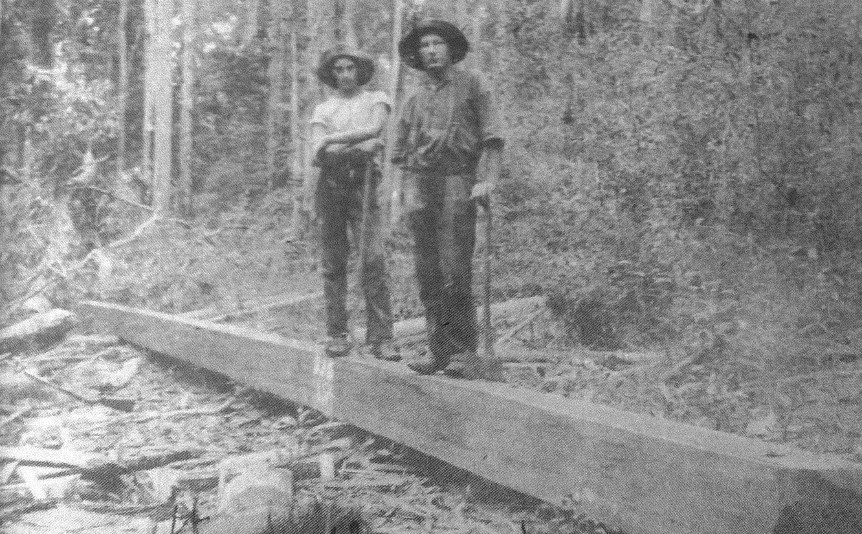
    Things were tough in the NSW North Coast forests in 1907. All the cedar had been cut years earlier, prices for hardwoods had slumped, and the best way to make money was by shaping girders and sleepers.

    Tamban Forest woodcutter Bob Cooper was lucky enough to snag an order for a huge 86 foot (26 m) girder from a Sydney construction company. Bob selected a giant ironbark tree, and skilfully felled it along the hill contour.

    After trimming off the branches Bob used a string line blackened with charcoal as a straight-edge, and over days of back-breaking labour with a broad axe, finally squared the girder into the required 16 inch (400mm) square dimensions.

    Promising a party for his friends and helpers on the basis of a forthcoming big cheque, Bob followed the girder as a bullock team dragged it down to Clybucca Creek, from which point it was punted up the Macleay River to Frederickton Wharf.

    Moored at the wharf was the graceful three masted top-sail schooner, Alma Doepel, of one hundred and thirty one tons displacement. One look at the boat was enough to tell that the girder was far too big for the hold.

    “No worries,” the captain said cheerfully, “we’ll get it aboard somehow.”

    Bob had some business in Kempsey to attend to, but returned a couple of hours later to see that the Alma Doepel was still at the wharf, with no sign of the big girder.

    “You got it in the hold?” Bob exclaimed. “How the hell did you do that?”

    “Easy,” the captain told him. “We just cut it in half. Then it fitted nicely.”

    History doesn’t record how Bob took that news. But apparently the party planned in celebration of a big cheque was cancelled.

    (Interestingly, the Alma Doepel, originally built in Bellingen, survives today as a sail training ship, and is berthed at No 2 Victoria Dock Melbourne undergoing a refit.)

    Written and Researched by Greg Barron.

    This is an excerpt from Galloping Jones and other True Stories from Australia’s History by Greg Barron. Available at ozbookstore.com

  • Catherine Coleman – Pioneer

    Catherine Cecilia Coleman wasn’t famous, but was typical of a generation of Australian settlers. She was born in Maitland, NSW in 1856, eldest of ten children. She married in 1871, at the age of 15, and had the first of her own children a couple of years later.

    Her husband, John Douglas Coleman, was determined to make his mark in business, and in 1887 the young family packed up and moved north. Their new home would be the land of opportunity, Western Queensland, a wilderness only just then being opened up to cattle and sheep.

    Arriving at Whittown (Isisford), near Longreach, the Barcoo River had broken its banks and was in full flood. Catherine’s quick-thinking brother Dan placed the young Catherine and her children in a large draper’s packing case and towed them across on a rope.

    John moved them further west to the fledgling town of Forest Grove (Arrilalah), a natural stop for drovers and teamsters making their way up the Thomson River.

    At Forest Grove John and Catherine built the mud-brick Club Hotel and a store, operating both for many years with the help of the resourceful Dan. The babies kept coming, and Catherine gave birth to ten children overall while mobs of cattle and sheep came up along the river bed, and dusty men in felt hats rode in to slake their thirst. Picnic races, held every few months, brought a colourful crowd of riders, punters and revellers in from stations and nearby towns.

    Then, in September 1888, the dream ended. John fell ill, and did not recover. He died on the 26th of September, and was buried up behind the pub.

    Catherine sold up and moved to Isisford, where she lived for 66 years. Her brother Dan also remained in the district. Even in her eighties Catherine was still slim and active, and could apparently read without glasses.

    Catherine died in August 1944 at the age of 88. Only four of her ten children outlived her. At the time of her death she was survived by 30 grandchildren, 29 great grandchildren, and 12 great-great grandchildren. Most still lived in the Isisford district at that stage.

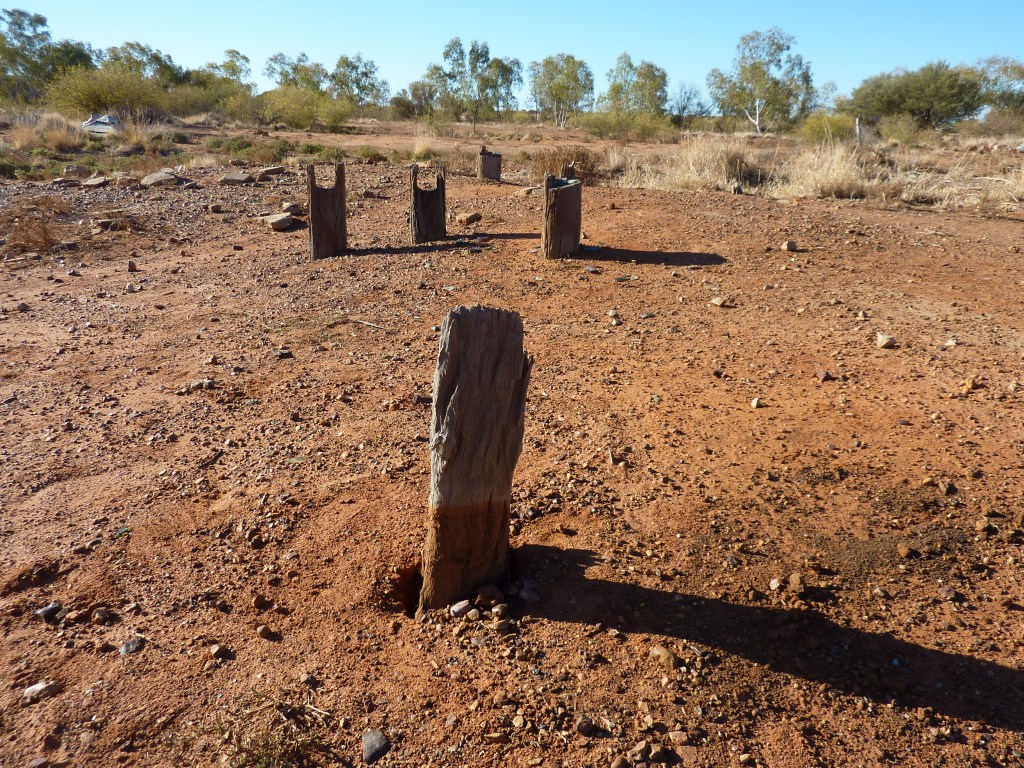
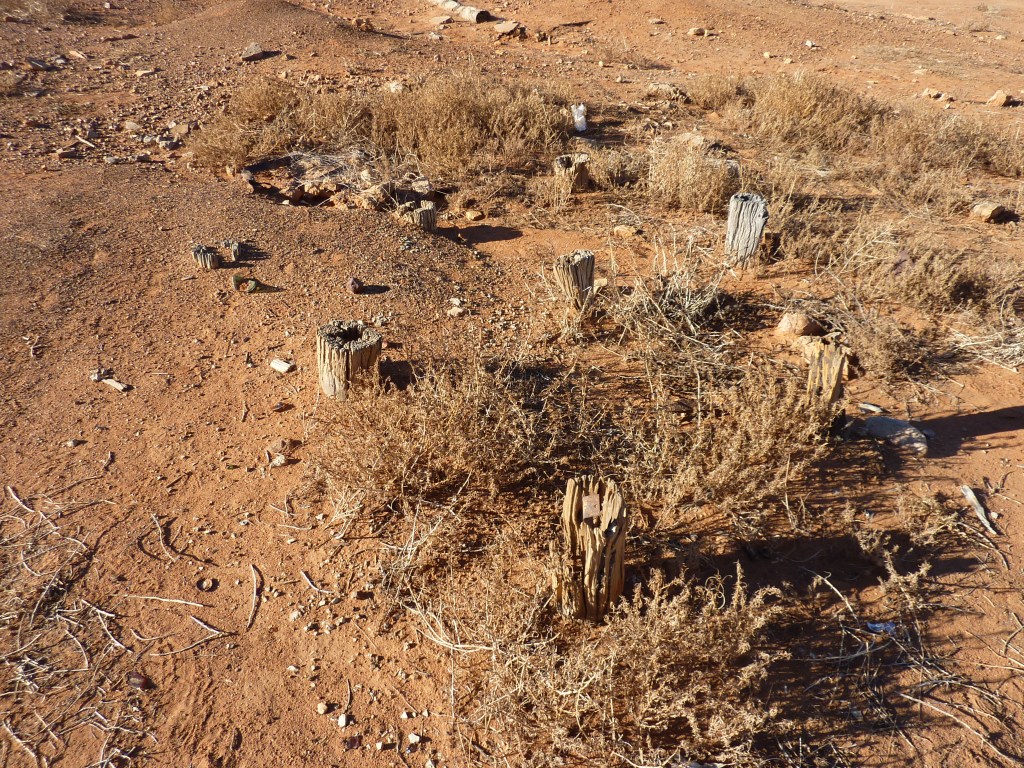
    There is nothing left of the once thriving town of Arrilalah now but ruins, some signage placed by the Longreach Historical Society, and one gravestone.


    Written and researched by Greg Barron.

    This is an excerpt from Galloping Jones and other True Stories from Australia’s History by Greg Barron. Available at ozbookstore.com
    Click here to view the sources for this story.


  • The Eulo Queen

    More than a century ago, when the town of Eulo was a thriving centre on the Western Queensland opal fields, one of Australia’s most interesting women set out to make her mark. She was a short but striking redhead, spoke English, French and German, wore tight-fitting dresses over a voluptuous body, and had a fully-stocked bar in her bedroom.

    Isobel Robinson, or the Eulo Queen, as she became known, was soon a legend from Quilpie to Lightning Ridge. Reputed to own the world’s finest collection of opals, she was also one of country Queensland’s biggest hoteliers, and boasted thousands of admirers. Every night she would hold court over the bar of the Royal Mail Hotel, carrying on with her delighted customers. Behind the fashionable gowns and diamond earrings, however, was a shrewd business brain.

    Right from the beginning, Isobel had attitude. She was a crack rifle and pistol shot, a brilliant billiards player and apparently a shrewd card cheat. She also liked men, marrying three times. Her first husband died only a few weeks after the wedding. The second was a station manager called William Robinson who invited her out to the Paroo, and they leased their first hotel together in around 1886.

    By 1902, when William died, they owned five pubs, a store and a butcher’s shop, but trouble was on the way. The Licensing Commission decided that Isobel was not a fit person to hold a liquor licence. She countered this by bribing travellers camped along the river to act as proxies, but when they decided that this entitled them to free beer, the writing was on the wall.

    Both the town of Eulo and its queen were in decline. Isobel enjoyed several “round the world” trips with rich squatters, then married again, to a man twenty-four years younger than her. The Eulo Queen’s bad luck with husbands continued. He was killed in action during World War One.

    Alfred Bourke, writing in the Sydney Morning Herald in 1951, remembered meeting the Eulo Queen in his youth.

    In 1921, I, a smooth-faced stripling, rode into Eulo with other drovers and met this still remarkable woman. Her ‘domain’ was then only a ramshackle store down by the banks of the Paroo. No trace of her beauty then remained, but her keen business instincts and feminine wiles were still much in evidence.

    Isobel died in a mental home in 1929, leaving an estate worth just thirty pounds.

    Story and Pictures by Greg Barron.

    This is an excerpt from Galloping Jones and other True Stories from Australia’s History by Greg Barron. Available at ozbookstore.com


    Click here to view the sources for this story.


  • Galloping Jones

    Galloping Jones


    Queensland has produced a character or two over the years, but John Decy ‘Galloping’ Jones takes some beating. Apart from being one of the most talented rough riders of his generation, and one hell of a bare-knuckle fighter, he was famously light-fingered.

    Galloping Jones got his nickname from a horse race where he and his mates prepared a ring-in. Apart from boot polish cunningly applied to a white blaze, part of the trick was to make the substitute’s tail longer.

    Unfortunately, the glue they used to fix the tail extensions started melting half way through the race. The crowd noticed pretty quickly. Jones and his mount reached the finish line ahead of the pack, but rather than face the stewards he just kept on galloping, through the gates and into the bush.

    One night Jones complained that when he walked into a pub everyone left.

    ‘I don’t leave,’ said a voice. Jones turned to see a big bloke called Treacle MacFarlane walking towards him.

    ‘And why don’t you leave, Treacle?’ ‘Because I can fight just as well as you can.’

    Legend has it that they fought for two hours before the bout was declared a draw.

    No one could best Jones on a horse, and his freakish ability to stay in the saddle saw him recruited to Lance Skuthorpe’s famous travelling show. Jones’s fame at riding buckjumpers was such that he would ride into town and dare locals to bring out their worst horses just so he could tame them. More than once, if he liked the horse, he lived up to his name and just kept on galloping.

    According to the Queenslander newspaper:

    ‘Galloping’ Jones has established the fact that he is a master horseman, and he is recognised as such today. As a horseman and stockman he is recognised as one of the central figures of the Gulf districts. He could be relied on to tame any horse that any other man had failed with, and while he may not quieten him sufficient for any ordinary rider he would never be thrown himself.

    Jones joined the AIF in World War One and came back with even less regard for authority than when he left. Police gazettes list charges against him for assault, creating a disturbance and using obscene language. He robbed at least one bank and was shot in the shoulder for resisting arrest. He was known to steal, sell, and then re-steal the same cattle on the same day.

    Another time, arrested for horse theft, he asked his captors for permission to head behind a bush for a ‘call of nature. ’When they went looking for him Jones had run off, but recapturing him wasn’t hard. The police found him at the nearest pub.

    Even past his prime, Jones was not afraid to stick his neck out. In 1926 the Northern Herald Newspaper carried a challenge from Jones to a boxer called Bob Smith to take him on for a prize of £25. The paper noted that, ‘Promoter Bob Ditton said that when he presented the agreements to Smith last night the latter seemed unwilling to meet Jones.’ One year later Jones appeared before the police magistrate in Rockhampton, charged with ‘using obscene language in a public place, assaulting Constable WH Langhorne whilst in execution of his duty, and resisting arrest.’

    There’s a sad side to all this. Jones married late in life and had three children. The relationship didn’t work out, and he was often in trouble for failing to provide maintenance payments. He was a free spirit and couldn’t stick to anything for long. That must have been hard on his family.

    As an old man, at Eventide nursing home in Charters Towers, Galloping Jones continued to cause trouble – fighting, getting drunk and wandering off to the pub. He died in 1959 of heart disease and emphysema.  

    This is an excerpt from Galloping Jones and other True Stories from Australia’s History by Greg Barron. Available at ozbookstore.com


    Click here to view the sources for this story.

  • Steele Rudd

    Steele Rudd2

    “It’s twenty years ago now since we settled on the Creek. Twenty years! I remember well the day we came from Stanthorpe, on Jerome’s dray – eight of us, and all the things – beds, tubs, a bucket, the two cedar chairs with the pine bottoms and backs that Dad put in them, some pint-pots and old Crib. It was a scorching hot day, too – talk about thirst! At every creek we came to we drank till it stopped running.”

    So begins the first-ever published story by Arthur Davis, better known as Steele Rudd.

    Born in 1868, Arthur Davis was six years old when he and his brothers and sisters, walking beside a cart piled high with furniture and farm equipment, arrived at “Shingle Hut” on the Darling Downs, there to make their fortune. “Dad” had arrived a few weeks earlier and knocked up a rough slab hut. Before long, through drought, flood and very occasional plenty the family had swelled to thirteen children.

    The young Arthur, was, according to a much later recollection by his son Eric; “six feet tall—active and athletic—his carriage was erect—also his seat on horseback. He had a ruddy complexion with twinkling brown eyes—keenly alert and observant, with wrinkles at his temples which lent a humorous outlook. Kindness was one of his virtues, and he was generous to the extreme.”

    At the local school, Emu Creek, Arthur was quiet and hard working. There was one little girl who liked to sit with him in the playground, and talk about horses, dogs and books. Her name was Christina Brodie, always called “Tean” for short.

    By the age of twelve Arthur had finished school and was earning a living ‘picking up’ at the woolshed on nearby Pilton Station, and honing his skills as a jockey at the local picnic races. After a stint as a drover “out west” his mother arranged for him to apply for the civil service. His application was successful and he soon found himself in the foreign world of turn-of-the-century Brisbane.

    His first job was with the office of the Curator of Intestate Estates, and a later book called “The Miserable Clerk” gives a clue to what he thought of this particular job. A flatmate, however, got him into reading Charles Dickens, and his interest in rowing led to him writing a series of articles under the pen name “Steele Rudder,” later changed to “Steele Rudd.”

    After a few years in the city he missed the bush life so much that he began to read everything he could about the outback. Eventually, he had a go at writing his own stories. His first sketch of life growing up in his boisterous family, “Starting the Selection,” was published in the Bulletin Magazine in 1895, championed by J.F. Archibald, the force behind so much great Australian literature.

    That same year, Arthur headed back home and asked his childhood sweetheart, Christina, to marry him. She was full of fun and good sense, and had a keen editing pen. It was “Tean” who first read and helped hone Arthur’s early stories.

    “On Our Selection” was published in full by the Bulletin Magazine in 1899, followed by “Our New Selection” in 1903. Both won popular and critical acclaim. Two of the main characters, Dad and Dave, became part of Australian folklore.

    Partly because his bosses were jealous of his success, Arthur was retrenched from his public service job, and responded by moving to Sydney and starting his own magazine. Nothing could keep him down. As his son Eric later said of him: “He was always a man’s man, tough, testy, a good friend.”

    All was not well with Tean. The lack of a steady family income tested her disposition. The magazine slowly dropped in sales, then was forced to close, making her state of mind worse. Believing that a big change might help, Arthur took the family back home to the Darling Downs, settling on a property called “The Firs,” where he bred polo ponies and entered local politics, becoming head of the Cambooya Shire Council.

    During World War One their son Gower was badly injured at the Somme, and Tean’s “frailty” became full blown mental illness. The family were forced to sell up and move to Brisbane where she could receive special care. She was hospitalised permanently in 1919, remaining there until her death more than twenty years later.

    “Steele Rudd” never stopped writing until his death in 1935, but made little money in his later years. A grateful nation endowed him with a “literary pension” to the tune of twenty-five shillings per week, for which he was apparently grateful.

    Arthur published many other books and stories over his lifetime, including his ill-fated magazine, and but nothing ever approached the freshness and honesty of his first two works, On our Selection, and Our new Selection. They are true classics, and an insight into how life was, “back then.”

    Written and Researched by Greg Barron.
    Click here to view the sources for this story.


    You can get this beautiful new edition including On our Selection and Our new Selection by Steele Rudd here: http://ozbookstore.com

    original

    This is an excerpt from Galloping Jones and other True Stories from Australia’s History by Greg Barron. Available at ozbookstore.com

  • Nemarluk

    Idriess

    Nemarluk was a fighting man of the Daly River people who would not be tamed. Born in 1911, by the 1930s he and a small band of young men were waging an effective guerrilla war against interlopers on his territory.

    The Fitzmaurice and Daly River areas had never been fully settled. With the region’s jagged sandstone gorges and winding rivers, pastoral pursuits were difficult, and supply routes subject to ambush. Nemarluk grew up in a time of conflict and, according to oral tradition, swore to keep his land free of outsiders, their laws, and their guns.

    Three Japanese shark fishermen sailed their lugger into the Daly River near Port Keats. Their names were Nagata, Yoshida and Owashi. They anchored in a backwater and made contact with Nemarluk and his community, who were camped on the river bank.

    Nemarluk was aware that the lugger was packed with stores, along with highly-prized iron and tobacco. He was also mindful of his oath to rid his lands of foreigners. He formulated a plan to attack and kill the Japanese without risking his people to their deadly guns.

    The first step was to make the Japanese trust them. They brought food aboard, served by the most attractive young women in the group. Nemarluk then suggested to Nagata, the captain, that he might go ashore to a lagoon and shoot as many ducks as he wanted.

    Nagata took up the invitation, and was delighted to find that the lagoon really was alive with ducks. He shot a great number, walking further along the banks as he went. Waiting until the Japanese captain was thigh deep in water, Nemarluk gave the signal. They attacked and killed him.

    Nemarluk took the geese back to the lugger, telling the other Japanese that Nagata was attempting to shoot some kangaroos. Once they were aboard the Aborigines produced hidden weapons and killed the rest of the crew.

    A frenzy of looting followed: more tobacco than they had seen in their lives, iron implements that could be filed down into spear points, along with blankets and vessels of all types. They also found guns.

    It was rumours of guns in the possession of the group that provoked a strong reaction from the NT Police. Two parties were soon on the trail of Nemarluk and his comrades. The most feared of these was the mounted policemen Pryor, Birt, and the tracker, Bulbul.

    Despite seeking refuge in the rugged Fitzmaurice region, most of Nemarluk’s comrades were arrested for murder and faced the death sentence. Months later their leader was also captured.

    Even then, Fannie Bay Jail could not hold this wild spirit. Nemarluk escaped by swimming across Darwin Harbour to the Cox Peninsula, a distance of at least eight kilometres.
    Heading back into his homelands, Nemarluk continued to elude the police for years. This article from the Northern Standard newspaper gives an account of his capture.

    “Nemarluk was captured after two and a half years of continuous searching by officers and black trackers, who covered 21,000 miles of country. The capture occurred when Constable Birt was stationed at Timber Creek, in the western part of the Territory. Black trackers who were in his charge found Nemarluk at Legune Station in March, 1934. Constable Birt later escorted Nemarluk to Darwin to face a three-year-old charge of having been concerned in the murder of three Japanese at Port Keats.

    “Nemarluk had been arrested after the murder, but escaped from the Fanny Bay Gaol, and was at large until Constable Birt’s trackers found him. Bulbul, the leading tracker, was also responsible for the recapture of Minemara, another escaped native murderer who had been concerned in the killing of the Japanese, and who was captured in June last year.”

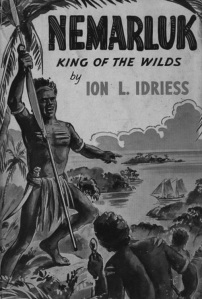
    Nemarluk’s exploits became the subject of a popular book by author Ion Idriess, who met the outlaw several times, and was impressed by his physical strength and demeanour.

    The dust jacket introduced the book with the romantic assertion: “Here now is Nemarluk’s life story – the tragic adventures of the young chief who was a living Tarzan of the wilds.”

    I doubt Idriess himself made that one up.

    Story and Pictures by Greg Barron.

    Get the book, ‘Galloping Jones and Other True Stories from Australia’s History’ at ozbookstore.com
    Click here to view the sources for this story.

  • Mary Watson of Lizard Island

    WP_20141116_022

    The ruins of a stone cottage, once the home of pioneer Mary Watson, lie crumbling up behind the beach at Watson’s Bay on Lizard Island, three hundred kilometres north of Cairns.

    Mary was born in Cornwall, and her family settled in Maryborough, Queensland, when she was seventeen. Both educated and musical, Mary easily won a position in Brisbane as a governess.

    Mary’s employer, Mr Bouel, decided that her talents were wasted teaching children. He took her to Cooktown to play piano in a hotel he owned there, and in that wild frontier town she grew up fast.

    Belting out popular tunes on the piano at the bar, Mary couldn’t help but notice when a handsome, fit man called Robert Watson swaggered in one night. Mary learned that he, in partnership with his mate Percy Fuller, ran a beche-de-mer (sea cucumber) fishing operation on Lizard Island.

    Seduced, perhaps, by tales of one of the world’s most beautiful islands, Mary married Bob a few weeks later, and packed for the journey north.

    By 1880, still just twenty years old, Mary was running an island household and a small farm with the help of some Chinese labourers. She kept a record of the trials and triumphs of her life in a journal, which survives to this day.

    Within a few months Mary was pregnant, and she returned to Cooktown where she gave birth to her son Thomas. Once she felt confident of her abilities in raising the child she headed back to Lizard Island and the love of her life.

    Bob, Percy and another man headed off to a distant island on a fishing trip. They had not noticed a fleet of canoes crossing the thirty-five kilometre stretch of water from the mainland.

    With most of the white men absent, the local Dingaal people, who had fished and hunted on the island for millennia, attacked. Ah Leong, one of the Chinese workers, was killed, and another seriously wounded.

    Mary, her baby Thomas, and the wounded man, Ah Sam, put to sea in a cut-down iron water tank. They drifted in terrible heat for eight days before washing up on an uninhabited island in the Howick Group.

    The final entry in Mary’s journal reads: “No water. Nearly dead with thirst.” Their bodies were found three months later, and transported to Cooktown for burial.

    Taking their cue from an outraged public, the local constabulary inflicted a terrible revenge on the Dingaal people. A sad end to a heart-wrenching tale.


    Story and Pictures by Greg Barron.

    Get the book, ‘Galloping Jones and Other True Stories from Australia’s History’ at ozbookstore.com

    Click here to view the sources for this story.