Tom Kilfoyle, a cousin of the pioneering Durack family, was Charlie Gaunt’s boss for much of the 1883-6 overland drive from the Channel Country in Queensland to Rosewood Station in the Kimberleys. Tom was born in County Clare, Ireland in 1842 but became a highly skilled bushman. Interestingly, he later married Catherine Byrne, a close relative of Joe Byrne from Ned Kelly’s gang.
Charlie Gaunt described Tom Kilfoyle as:
“a splendid bushman, stockman and of strict integrity: almost puritanically so; bluff, quick of temper but with the heart and simplicity of a child.”
Tom died in Port Darwin in 1908, leaving behind Catherine and his son Jack, who successfully ran Rosewood Station, becoming an important figure in Western Australian pastoral history.
Written and researched by Greg Barron
This is an excerpt from Galloping Jones and other True Stories from Australia’s History by Greg Barron. Available at ozbookstore.com
One of the parts of Charlie Gaunt’s life that I would have liked to explore more in Whistler’s Bones, but it didn’t fit into the story, was his years skippering a pearl lugger out of Broome in the 1890s.
Charlie was able to throw in with a partner, a local businessman called Stanley Piggott, to commission a lugger. The keel was laid by the firm of Chamberlain, down in Fremantle.
Charlie engaged a Japanese diver, a tender (a man to row out with the diver), and a four-man-crew. After provisioning the lugger, now named Mona, Charlie sailed her north to Cygnet Bay, Kings Sound.
In Charlie’s words:
Cygnet Bay in those days was known as the Diver’s Graveyard, it had strong currents, deep water and a foul bottom. The shell also was of poor quality – big old shell very rarely carrying good pearls; all Baroque (misshapen pearls worth about twelve pounds per ounce, used by the Chinese to grind into an eye powder).
My diver by the name of Muchisuki was a splendid man but had one fault, being too reckless. He seemed to enjoy gambling with death and at times took great chances. We worked amongst the fleet of luggers, all on good shell. For a neap tide or two nothing unusual happened, until one day a flag was hoisted half-mast on one of Captain Redell’s luggers. An accident had happened. Several luggers raced to the scene, to render aid.
My lugger being the first to get to the lugger, my diver called out, “What’s the trouble?”
The tender of the other lugger replied, “My diver is fouled and I can’t get him up.” Getting helmet and face glass on quickly, Muchisuki descended in haste to assist the unfortunate diver. In about five minutes he came up and as soon as we got him on deck he sang out to the tender, “Heave up your anchor and you’ll get your man.”
The crew rushed to the winch, hove up their anchor and found the diver entangled around the flukes. The goose neck had been broken off the helmet, the diver’s skull was smashed in, and he was dead as a door nail. The flukes of the anchor, swinging to and fro had crushed the helmet into a shapeless mass, and then fouled the life line and pipe. The cause of the accident was this: when a diver worked below the vessel drifted after him, the anchor, lowered over, acted as a brake. The more chain paid out the lower the anchor and slower the progress of the lugger. When the anchor was heaved in the faster the lugger would drift. Now, this diver had been working close to the anchor: which was about a fathom from the bottom and his lines, getting foul of the anchor, through the action of the strong current, he was wound round and round the chain, the flukes swinging backwards and forwards dealing him smashing blows on the head.
One day, Charlie’s diver, Muchisuki, stayed below for too long, and he stopped responding to signal tugs on the lifeline.
Myself and the tender heaved on the lifeline and could feel dead weight. Pulling him to the ladder his both hands hanging uselessly down, we knew he was paralysed or dead.
Muchisuki had been diving in water twenty three fathoms deep – more than forty metres. Apart from the tragedy of losing a man Charlie respected, the death put financial pressure on the enterprise.
With no cash to employ another diver Charlie took on the role himself, and the man who once roamed the savannah and open woodland of Australia’s north, now worked the bottom of the sea. Up to three miles a day he wandered, collecting shell, and admiring the sea floor.
The submarine scenery in places is almost indescribable. Walking the bottom prospecting for shell the diver will often cover a distance of two or three miles, beds of silver sands, now coming to great fields of waving sea exactly the same as fields of wheat waving with the tide as if a gentle breeze was fanning it. Through those fields and on to beds of beautiful white coral; over them and onto beds of beautiful flowers of many different hues. (When these flowers are brought to the surface and exposed to the air they turn black and have a rank smell).
On over big ironstone ridges, dark caverns, black and forbidding looking, then through a forest of coral cups from the size of a cabbage up to forty feet high, stems two feet through, like champagne glasses. The great feeding ground of fish of all species and the home of some of the best actors of the deep. In some places myriads of fish, red and silver schnapper, white fish and others will swarm around the diver, looking curiously in his face glass.
Charlie had run-ins with eighteen foot-long sharks and huge diamond fish that became entangled in the lines and dragged a helpless driver behind in their panic to be free. Despite the dangerous work, he soon proved that he could do the job profitably.
The first month I brought up about half a ton of pearl shell, and beautiful shell it was. I also got a few pearls.
For three and a half years Charlie carried on his dual roles as skipper and diver, but theft of decent pearls by employees was a constant problem, and pearl shell prices were tumbling. Besides, Charlie as always, had itchy feet. It was time to move on.
The story of Charlie Gaunt is documented in the book, Whistler’s Bones by Greg Barron. The book is available from good bookstores and direct from the publisher at ozbookstore.com
One of the most touching stories from Charlie Gaunt’s later years came from a time when he’d left the Australian outback far behind and wandered the Western States of America as a hobo. This is one of many periods of his life there just wasn’t room for in the book.
“From Colorado I hopped fast passenger and freights, today in one state tomorrow in another, and at last my few dollars played out and I was then thrown on my wits and resources. I was now a bum, pure and simple – not really simple, for I took to it like a babe to its mother’s milk. All and sundry I hit up, rich and poor. Shrimps gave good feed as well as the whale. Certainly I chopped wood or did an odd job for the poor lone woman with a yardful of brats, but I avoided doing anything for the wealthy.”
On winter days with no food or shelter Charlie would sometimes knock on a respectable door to ask for help – cadging meals in return for stories, and it’s likely that this was when he refined his yarns, helping remember the detail for that far off day when he decided to write them down.
Source: Getty Images
Before I could say any more a beautiful girl about seventeen came out of a room into the hall and said, “Who is it, Chloe?”
The maid answered, “Oh, Miss Agnes, only a bum. He wants a drink of coffee.”
The young girl now came to the door and said, “What can we do for you?” and “Shut the door,” she said to the coloured girl.
I spun the tale to the young lady and she caught hold of my hand. “My goodness,” she said with alarm, “Your hand is almost frozen off. Come,” and forthwith I followed her, cap in hand. She led me into a beautiful well-lighted room. Leisurely seated in comfortable chairs were an aristocratic looking old gentleman, hair as long and as white as the driven snow, an old lady; white like the old gentleman, with refined features showing signs of great beauty in her younger days, two lovely young girls and a lad of about eighteen.
They were the most refined and aristocratic family I had ever met or seen. “Dad,” said the young girl, “Here’s a hobo nearly frozen. Today’s my birthday. Can’t we be charitable and let him know that tonight somebody cares for him?”
The old gentleman got up, took my hand, shook it, and all the others did likewise. “Sit down,” he said, and reaching for a decanter of whisky poured me out a stiff peg. “Drink this,” he said and I drank it. It put new life into me.
They had just finished their dinner and the viands had not been cleared away. What a repast! Every time I felt hungry afterwards the vision of that well stocked table used to come before me. “We’ve just finished dinner,” said the old gentleman. “Sit down,” and calling to the maid, gave her orders for a fresh supply to be brought in.
T’was a feast for the gods. Boiled turkey with cream sauce, vegetables of all sorts, a splendid dessert with coffee and last but not least a splendid cigar to top off with. After I had had a sumptuous dinner, which I certainly did justice to, they began to question me. I told them part of my life and adventures – all truth, solid truth.
I couldn’t lie to those people, their courtesy and kindness forbade it. I could not act the part of a hobo. I had to act the part of a man. Like Old Hayseed and his family, these aristocrats were immensely interested in my tales. They told me they were from the Shenandoah Valley, Virginia, originally were tobacco planters, and came to live in Pueblo for a suitable climate for the old lady. After a pleasant evening had passed, the old gentleman got up went out of the room, returning in a short time he put an envelope into my hand saying, “A small token for the interesting evening you have given myself, wife, and family.”
I bid them all good night and thanked them sincerely. The young lady whom I had met first escorted me to the door. “Wait a moment,” she said. Running up the stairs she soon came back with a parcel in her hand. Handing it to me she said, “There’s a combination suit of underclothes. You and I are about the same height,” and with a sweet smile she said, “You don’t mind, do you?” and thanking her I said good night and went to look for a bed.
I soon found a rooming house at twenty five cents a room. Lighting the candle I sat on the edge of the bed, took out the envelope, opened it and drew out six crisp and clean five dollar notes – thirty dollars in all (English pounds, six). I then opened the parcel and there was a beautiful suit of lamb’s wool combination underclothes.
The story of Charlie Gaunt is documented in the book, Whistler’s Bones by Greg Barron. The book is available from good bookstores and direct from the publisher at ozbookstore.com
The Mersey under sail. Photo courtesy State Library of South Australia
Charlie Gaunt was in his late thirties, veteran of the Northern Territory cattle trails, and a hard-fought Boer War, when he began several decades of international wandering. His willingness to work as a seaman took him wherever he wanted to go.
Since Whistler’s Bones is essentially a novel about Charlie’s Australian experiences, there was no room for these stories, but they’re fascinating nonetheless, and it’s great to be able to post them here.
The Slave Ship by Charlie Gaunt appeared in the Northern Territory Standard newspaper on the 6. 10, and 13th of November, 1931.
Broke, in the Sailors Home Calcutta, sitting on a bench amongst a lot of old seasoned shellbacks; men who had sailed seven seas; schooner men, whale sealers from the Pribilof Islands, men who had been in the blackbirding trade in ‘the southern seas,’ young lads who had only done their first or second trip at sea.
Old and rugged were some, with hands knotted and gnarled, impregnated with Stockholm tar that would not wash off, and the grip of an Orang Outang. Faces seamed and scarred with the gales of the Arctic and howling typhoons of the China Seas. But, age counts nothing, the shipowner wants your work, not your body, and a “Bucko Mate” is there to get it out of you and he gets it, or you’ll wish yourself in hell for signing on for job you cannot fulfil. Officers and crew have no time for an inexperienced man or a slacker.
What tales those old seamen could tell, a couple of nobblers of rum and a plug of tobacco would draw them out of their shell. And I with my limited experience of the sea, only on luggers, pearling, felt very small amongst that seasoned brigade. But I was desperate. I’d have shipped aboard a Nova Scotia blood ship. Too long had I stood the famine and I was getting fed up and longed for the feast. All the crowd at the Home was dead broke. You could not squeeze a rupee out of the lot and every man eager to get ship and the coveted advance note (a month’s pay in advance before going aboard after signing articles) and having a night’s outing amongst the girls and the rum, before embarking on perhaps a floating hell.
We all sat on those benches in that big room in a listless manner, scheming how we could raise the wind for a bit of tobacco or a bottle of rum. Presently, while we were moralising over our past sins, the Runner of the Home came in and in a loud voice said, “Who wants a ship for the West Indies?” We all jumped to our feet. He continued, “Ship Mersey loading twelve hundred and fifty coolies at Kidderpore Barracoons, sailing day after tomorrow’s tide. AB’s (able seaman) is fifty four rupees per month, ordinary seamen thirty rupees. The run is one hundred and twenty five days, more or less, destination Port of Spain, Island of Trinidad. Now boys, who’s going to ship? I want a double crew, thirty two men (Indian coolie ships were compelled to carry double crews).
Every man in the room in one voice said, “Aye.” Twenty eight of us, and headed by the Runner we marched to the Shipping Office. When we entered the office the Captain was there, and the Shipping Clerk sat with the articles before him on the desk. We all lined up and Captain Douglas, of the Mersey sized us up. He looked us up from the feet to the chin. Muscle and thew he wanted, brains didn’t count. Signing the A.B.s first who were handed the articles and conditions of food, to read. If satisfactory they signed their name and received the Advance Note with the remark from the Captain, “Be aboard before midnight tomorrow.”
I was fifth in the line and when I read the articles, “Three years or any Port in the United Kingdom.” I handed the paper back to the clerk with the remark, “Cut me out, I’ll not sign those articles.”
“Why?” asked the Captain. “They are in order.”
“In order,” I said, “but when you land those Coolies in Port of Spain, where do you go from there?”
The Captain said, “We load sugar at Barbados for New York, thence to Pensacola and load hard pine for England, and then you get your discharge.”
“I’ll sign for Port of Spain,” I said, “and no farther. Give me my discharge in Trinidad and I’ll sign.”
The skipper sized me up and seeing I was a likely looking A.B. said, “All right. I’ll sign you off in Port of Spain.” (It took, as I afterwards found out, nearly three years for the “Mersey” to reach Great Britain). I then signed the Articles and after the Runner got the rest of the men and they all signed on we got our Advance Notes went out, cashed them and then hit the high places. The following evening I, with part of the crew, went down to Kidderpore docks, found the Mersey and went aboard.
The Mersey was a full rigged steel ship, about three thousand nine hundred tons, hailing from Liverpool, England, and with her sister ships the Elbe, Lena, and Rhone she was engaged in the coolie trade of the West Indies. Stragglers came to the Mersey all through the night, some drunk and muddled and threw themselves into the bunks of the forecastle to sleep off the effects of the liquor. About midday the tide being in full flood and the crew all on board the tug boat Hugli took hold of us pulled us out into stream and like a toy terrier pulling a huge mastiff, towed us out of the river to the sea.
Before continuing this article a word regarding the West India coolie trade. Babus (recruiting agents get into the farming districts in Province of Bengal. With a promise of big wages and a glowing account of the land he is going to, only, says the Babu, distant about one day from Calcutta, he gathers the unsuspecting coolies in mobs, takes them men, women and children, to Kidderpore Barracoons three miles below Calcutta (Barracoon being a big walled in compound) and once the Babu gets them in, the massive gates are shut and coolies carefully handled and are kept until the number required is got together, and then put aboard. The coolie for the plantation of the West Indies is indentured for three years at a wage of eighteen pounds per year and food and housing. When the coolies find they have been deceived regarding one day’s sail from Calcutta and for days see only the open sea they try to jump over the side and drown, which many succeed in doing, as a Bengali loses caste when he crosses the sea.
Now the white doctor in charge of the coolies looking after health and welfare gets a guinea a head on safe delivery in Port of Spain, the Captain ten shillings, the mate seven and six pence, second mate five shillings and third mate half a crown, and the crew nothing, only work.
On the way down the river the mate mustered all the crew at the break of the poop to divide us into watches, he taking one watch, the second mate the other. Thirty-two of us lined up, the mate leaning over the rail closely inspecting us as a pig judge would inspect a pen of prize pigs. Amongst the crowd was big burly Swede, pipe stuck in his mouth. The Mate noticing it left the poop rail, walked down the ladder, strode up to the Swede and dealt him a smashing blow in the face, laying him flat on the deck, remarking: “Smoking is not allowed aft on this hooker.”
I said to myself, “A twenty-four carat Bucko Mate alright” and later on I found it out. The mate and the second mate then picked their watches, the mate taking port watch, second taking starboard watch. Sixteen men on each watch, and it fell to me to be one of the Mate’s watch. After the watches were picked the Mate climbed the ladder and leaned over the poop rail and as we started to walk away he called us all back. “Now men,” he said, “any man who has shipped aboard this ship as an able seaman under false pretences and he cannot hold his end up, I’ll make him wish he had never been born. You’ll find me a hard mate, but we’ve got twelve hundred and fifty lives on this ship and we want seamen, not farmers. Do your work and keep a civil tongue in your heads and when and addressing an officer, say, “Sir,” and you’ll find me a just man.
Captain Douglas knew his mate, a hard mate but one of the finest seamen who ever trod the deck of a ship. Armstrong was his name, a Bluenose (Nova Scotian) about thirty five years of age, tall and wiry, weighed about twelve stone, as agile and active as a cat, knew no fear and could hit like a sledge hammer. Truly a Bucko Mate.
After this address of the mate’s I got a nasty taste in my mouth as if I had taken a big dose of quinine. Here was I who had never been on a square rigged ship in my life, only a schooner man, and had never been aloft. Certainly I could do my trick at the wheel, was a good steersman, but didn’t know a rope on a square rigger. But, I had the consolation of knowing that two of the crew that signed on as able seamen were Howra railway firemen and had never had a deck of a ship under their feet. (The Howra is a railroad that runs from Calcutta to Bombay).
“God,” I thought, “How will they fare with this Bucko Mate,” but soon I was destined to find out When the tug let go of us well out from the Sunderbunds at the mouth of the Hoogli we went aloft and unfurled our sails. We sped across the Bay of Bengal eight hundred miles with a freshening breeze on the port quarter. She was now blowing a stiff breeze. Seas were getting up, great big green fellows, white-capped and the vessel with all the sail she could carry was forging rapidly ahead, driven through the head seas with the force of canvas behind her, going straight in to them instead of riding over them, shipping tons of water over the forecastle head, feet of water rushing aft along the main deck. When she cleared a big mountainous sea the ship would shake herself like some huge water dog and meet the oncoming sea again. The mate was pacing the poop. I was engaged cleaning bright work close to the binnacle when who should come up on the poop but one of the Howra firemen to relieve the man at the wheel. When the fireman took the wheel from the other, wheelsman, he the relieved man, gave the course. Nor-east half by east. The fireman took the wheel but did not answer. Now when relieving a man at a wheel you must always repeat the course given by the relieved seaman, so that you have the course right. No answer was a dead giveaway showing that the fireman had never done a trick at the wheel in his life.
The Mate, nothing missing him, noticed it and, strode up to the wheel and said to the fireman “Did you sign the articles as an Able Seaman?”
“Yes sir,” he answered. By this time the ship was off her course. Instead of heading and easing her up to the big seas she had fallen off and the needle of the compass was chasing itself round the compass like a cat at play. The Mate dealt the fireman a blow that would have felled an ox and he fell an inert mass on the poop deck. I instantly jumped and grabbed the wheel and threw the vessel up meeting a mountainous sea, just in the nick of time. If that big sea had hit her when she was wallowing in the trough, it would have struck her on the beam and nothing could have saved the Mersey. She would have turned turtle and ship, all hands, and coolies also, would have been at the bottom of the Bay of Bengal.
Stooping over the now insensible fireman the mate picked him up as a cat would a mouse and threw him down the poop ladder on to the main deck and calling a couple of hands to carry the injured man to the forecastle. Walking over to me he said, “What’s your name, I’ve forgotten it.”
“Gaunt, sir,” I answered.
“Well Gaunt,” he said, “You did well. I’ll not forget it. Ease her up a little,” he continued, as a big monstrous sea was coming straight at us. I eased her and she took it beautifully, the mate and I watching it with bated breaths, and he continued to pace the poop as if nothing out of the ordinary had happened.
After this incident the crew in the forecastle became unsettled and muttered threats were often heard to do the mate in. One day the Mate’s watch was aloft putting new gaskets on the upper top sail yardarm. I was amongst them. We all had marlinspikes with a loop of marlin through the eye of the spike and suspended around our necks. (A marlinspike is of steel thick at one end and tapering off to a needle point, about ten inches long; with an eye in the thick end to pass the marlinspike’s twine-through, so if it fell out of our hands it would be suspended from the neck and would not fall on deck). It was about eighty five feet from the deck to the top sail yard. The Mate was standing on the deck directly underneath when suddenly a marlin spike dropped from the yardarm, and whizzing through the air buried itself about an inch and a half in the deck right at the Mate’s feet. He never moved or batted an eye.
Calling all hands from aloft he waited till we reached the deck and examined us. Tommy Payne, an A.B. had no spike and a broken marlin. “You dropped that spike,” he asked. “Yes,” said Payne, “The marlin broke.” The mate examined the two broken ends of the line. Sure enough they were frayed. “Go aloft and resume work,” said the Mate and the incident was closed. Payne had deliberately cut the marlin, frayed both ends and waiting a favourable opportunity dropped the spike aiming for the Mate’s head. The shot missed but it nearly got him. If it had hit him in the head it would have gone clean through him. It missed him by a very narrow margin.
Some time later we struck the East African coast at Cape Agulhas and ran into a terrific gale, with head winds and mountainous seas. For ten days we battled with the elements and could not pass the Cape. At daylight every morning we were on a lee shore, beat out and back again. Decks awash and forecastle flooded, nearly all the time, the two watchers on deck, and when at last we left the Cape behind the good ship Mersey had a worn out and exhausted crew. Through that gale the Mersey proved what a splendid ship she was. Like a living thing she battled with those seas. They used to pound her; they came, over the top of her with mighty blows: they used to throw her over almost on her beam ends; but she returned to the fight scarred but unbeaten although stripped of boats and deck fittings, iron stanchions broken and bent, cook’s galley gone that noble ship took her medicine and shook herself free every time, toiling and striving to free herself of the grasp of that terrific gale.
For ten days she fought wind, rain and seas and came out of it battered, bruised, but triumphant. That’s when I saw the seamanship of our Mate. Tireless, always leading in dangerous jobs, working like an able seaman, he did the work of three men and with the help of Captain Douglas, himself a splendid seaman, the ship answered every call they made, like a well-trained sheep dog obeys the call of its master. But this is not a tale of a Bucko Mate, it’s a narrative of the voyage of the good ship Mersey. At last we rounded the Cape of Good Hope, and set a course for the island of St. Helena, the last home of the Emperor Napoleon.
The weather now being good the coolies used to be brought on deck in batches and had to be watched carefully as odd ones, if they got a chance, would hop on to the bulwarks and take a header into the sea. Our grub was bad-hard tack biscuits that the maggots and weevils had left, salt pork and beef that had been killed when Adam was a boy, condemned navy stores, burnt peas for coffee, and four quarts of water per man per day. Soft bread once a week, and a plum duff on Sunday. Arriving, at St. Helena we took on sheep, fowls and geese for the consumption of the captain and officers only. Leaving, there we set a course for the South American coast.
“Everything spick and span,” was his motto and he kept us to it. About eight o’clock one morning the lookout sang out, “Land on the starboard bow,” and Cape Verde hove in sight. The weather was now unsettled; mare’s tails were scudding across the horizon; the wind coming off the land began to freshen; dark ominous-looking clouds began to gather and there was every indication of a coming storm. Coolies were sent below and hatches battered down. With the two watches on deck we were soon aloft stripping the kites off her and none too soon. The dreaded pampanero, or South American tornado, was upon us. When the pampanero struck us the ship heeled over forty five, degrees, , righted herself, shuddered from stem to stern, and then raced before that, terrible gale like a fox with a full cry pack of hounds after him. The terrific force of the wind lifted the sea and hung it at us like thrown sand off a shovel; the air was full of spume, like goose feathers; you could hardly see the length of the ship.
Then the rain started, light at first, hitting the deck like the pattering of children’s feet, increasing to a terrific downpour, it seemed the bottom had fallen out of the heavens. Leaning on the poop rail was Captain Douglas roaring out his orders to the Mate who was using all his skill and seamanship to guide the Mersey on her mad race. At times the wind would lull, stop almost, and then come back at us with redoubled force, lifting the ship almost out of the water.
The day grew dark, with a, leaden sky and with the goose feathers in the air it was almost as black as night. Towards evening the gale had spent itself leaving in its wake tremendous sea, but with a light head sail that noble ship rode her seas like a gull.
As soon as the seas abated and the weather got settled, up aloft we went and soon the Mersey had every stitch of canvas, stem sails and all, on her sticks. The Old Man drove his ship as his Mate did his crew. Up the coast we ran passing Georgetown and Demerara, leaving Barbados on our port bow. A few days later we sighted the high mountains of the Island of Trinidad. Swinging around the point at La Brae we came to anchor in the roads opposite Port of Spain, after a trip of one hundred and twenty nine days.
The boats came off to the ship and the twelve hundred and fifty coolies were soon landed and on their way to the different sugar plantations to which they were assigned. Next day (after bidding farewell to all my shipmates and officers) the Mate, gave me a hearty grip and squeezed three golden sovereigns into my palm saying, “Rum is only twopence a bottle over there in the Port and the Creole girls are good. Take care of yourself and good luck.”
I went ashore with the Captain and signed off, a free man once more with a good pay note. As I write these lines, an old age pensioner, existing on a mere pittance far away from Port of Spain, a picture like a cinema picture passes before my eyes. I see the Mersey as I saw her on a bright moonlit night lying at the break of the poop with the watch in easy call of the Mate’s whistle.
Lying on my back I gaze aloft: Lofty spars, sails all full and drawing, stemsails well out on port and starboard sides, like great wings, as with a fair wind she glides through the water like a beautiful white swan. I marvel at man’s handiwork. Today she lies in a haven of rest. She now lies in Southampton Water, England, a training ship for the White Star Line, turning out officers and cadets for steam.
Another scene passes. I see Captain John Douglas, of seventy odd summers, big moulded, a keen grey eye, leaning over the poop rail in his oilskins and sou’ wester, roaring his orders like a bull; truly a great seaman and mariner. No doubt old John has by now “crossed the bar.”
Again I see Abel Armstrong, our blue nose Nova Scotia mate who loved the good ship Mersey as an ardent lover loved his beautiful week old bride. The ship was his bride and he didn’t forget to let his crew know it. We were her chamber maids to wash her face very clean every morning and keep her dressed faultlessly. The crew hated, feared, and respected him but a deep water man is a poor hater. He soon forgets on reaching his port of discharge. Where is that Bucko Mate now? Is he still sailing the seven seas? Not on a coffee pot I’ll bet. He hated steam. Perhaps he’s on one of those Nova Scotia schooners trading to the West Indies, a master now, or perhaps owner.
Again the picture changes. I see my old shipmates of the forecastle. I fancy I hear them singing the old shanty, “Rolling Home to Merrie England,” as they beat it up the English Channel. Again I see them and the Mersey fast at the East London docks, their, long voyage finished, and the crowd in their shore going togs making for the shipping office to sign off and draw their three years pay. And then seven men from all the world, back to port again.
Rolling down the Ratcliffe Road, drunk and raising Cain,
Give the girls another drink, before, we sign away,
We that took the “Bolivar,” out across the bay. (With apologies to Rudyard Kipling).
Again I see them sitting in the Sailors Home in London as we sat in the Home in Calcutta, broke and down and out and the runner comes in and says, “Who wants to ship on an outward bound ship?” and it’s the old, old story. Up they go to the shipping office, sign on, receive their advance note, go aboard, and in no time are beating down the English Channel and as the articles call for “Three years or any port in the United Kingdom’” is the sentence! A good ship it may be or perhaps a floating hell – with a Bucko Mate.’
The story of Charlie Gaunt is documented in the book, Whistler’s Bones by Greg Barron. The book is available from good bookstores and direct from the publisher at ozbookstore.com
View of Lake Nash in better times, circa 1925. (Photo: John Oxley Library)
In 1889 Charlie Gaunt was working on Lake Nash Station, near the NT/Queensland border first breaking horses and then as a stockman.
Lake Nash Station was, at the time Charlie arrived there, under the ownership of John Costello. John’s pride and joy, Valley of Springs Station had, by this stage, been abandoned.
John Costello’s son Martin was managing Lake Nash. Back in Goulburn in his teens Martin had felt himself called to Holy Orders, but quit after a few months. Life on a cattle station must have appealed, and his father had plans for Martin to eventually take over as owner. He was, according to Charlie:
About twenty-five years of age, a splendid type of an Irish Australian, a chip off the old block; only lacking experience; a thoroughbred and a perfect gentleman.
When the horse-breaking was done Charlie signed on as stockman, but things on the station were dire. The 1889 wet season had been light, and in 1890 the rain didn’t come at all. This was Charlie’s story of a mad dash to a big waterhole in the Rankin River, attempting to save the remaining cattle.
In Charlie’s own words:
The drought hung like a great funeral shroud over a vast extent of country. Roxburgh and Carrandotta, having the only permanent water, held out. Headingly Station, adjoining Lake Nash, lost eighteen thousand head in four days. Lake Nash assumed the spectacle of a huge burying ground for stock, a mass of liquid mud with hundreds of cattle packing that oozy slime, bogged, dead and dying, with others roaming around the banks bellowing and maddened by thirst.
Costello decided that they had to try something – gathering up the strongest cattle and trying for the nearest permanent water – the Big Hole on the Rankin River, eighty miles away. They sent a dray and horses on ahead, and mustered every animal they could find and set off.
The heat at that time, January, was unbearable, and the dry storms made it worse with the hot winds. We had great difficulty getting the mob away from that charnel house and lake of liquid mud, but once they got going they strung up the river almost without any urging. The day wore on and night came and still those perishing cattle moved slowly along.
After a day and a night of travelling, they reached Austral Downs station, which had been abandoned to the drought. With just twenty miles to go now Charlie rode across to check the station tanks and found enough water to keep the horses going.
At least the horses had drunk their fill as they followed the thirst-maddened cattle down the left branch of the Rankin River. The sun was getting higher, however, and the heat intensifying.
The big body of the cattle kept following that spirit “Further Still.” The only sound they made was a low moaning. As evening came I rode up on the side to see how the lead was getting along, accompanied by Mick Scanlon. We rode a full six miles before we reached it. All along the line we noticed cattle dropping and dying but yet that line piled up the empty spaces. Great strong bullocks formed the lead and you dared not go near them. They were thoroughly thirst-maddened.
It was now dark and we rode close to the lead, when a demented bullock charged my horse, knocking it down and throwing me out of the saddle. We were amongst the infuriated animals and didn’t know it, the night being inky black.
I jumped up and shinnied up a tree close by and yelled to Mick to save himself, telling him I was alright, and that I’d stay in the tree fork till daylight. Mick soon got out of that maddened line of cattle and I saw him no more that night. All night long those thirst crazed cattle passed under that tree and I, sitting in the fork, hardly able to keep awake, waited for the dawn.
When, at last, daylight came, I got out of the tree and walked over to my horse. He was lying dead with a great wound behind the shoulder having bled to death. Removing the saddle and bridle I threw them on my back and started to walk up the river. After walking about four miles, dodging cattle, at last I struck the Big Hole and the camp. I was, like those stricken cattle – perishing for a drink. I had had no water since the day before at midday.
What a tragic scene was being enacted around that waterhole! Maddened cattle, some blind with thirst, moaning and walking through the water, being too far gone to drink. Up the bank they went and wandered out on the downs. After the drought broke we found that some of them had wandered six miles out from the river before dying.
The tail-enders drifted in and these represented the last of the living. Our men were now all in camp and we gladly sat down to a hot breakfast. Camped on a high bank overlooking the water we were in full view of that theatre. Only about five hundred head were left out of four thousand and were the remnant of a herd of fifteen thousand. The Big Hole where the cattle were, was on Avon Downs country, and John Affleck, manager of Avon, charged young Costello £100 per month for the right to use the water and surrounding country. It was a most unneighbourly and cowardly action to a now ruined brother stockman, but John Affleck was, a hard, hungry and mean Scotsman and he well knew that Costello had to accede to his terms. It was especially mean on account of the country being idle and not used by the Avon Downs people.
We, spectators of that terrible drama of crazed cattle wandering around the banks of that waterhole, piling into it, and gorging themselves. In some cases animals staggering out on the banks and lying down to die overgorged, the water flowing out of their nostrils as they drew their last breath.
On the bank nearest the camp some horses were standing and amongst them was a magnificent chestnut horse young Costello had brought from Goulburn. This animal was the young fellow’s pride. A maddened bullock, staggering along the creek saw the horse, made a desperate charge at it and tipped the entrails out of him. Martin Costello said, “Oh, my God, my horse.”
And the tears slowly coursed down his face. The long pent up agony that the young fellow had gone and was going through was at last broken by this incident. Fate had dealt him a cruel blow. He got up, walked behind the dray, sat down, and with his head resting on his arms and knees he had the dejected attitude of a heartbroken man. Every man around the breakfast table felt the position keenly and there was a lump in everyone’s throat. I know there was one in mine.
In the beginning of March; the arch fiend “Drought” was killed by one of the heaviest wet seasons known for years and we collected the remnants (five hundred head of cattle) of the Lake Nash herd and went back to reform the station.
The story of Charlie Gaunt is documented in the book, Whistler’s Bones by Greg Barron. The book is available from good bookstores and direct from the publisher at ozbookstore.com
As an old man Charlie Gaunt wrote in the Northern Standard Newspaper (May 29 1934):
“The head of (Edward) Lenehan we wrapped in a saddlecloth and carried into Broadmere. At the foot of one of those giant paper bark trees it now rests and with the help of a carpenter’s chisel, stripping the bark, we chiselled, ‘Here lies the head of E. Lenehan, murdered by blacks. Only part recovered.’ Below we cut the date.”
Visiting the area in July this year my wife and I searched the paperbarks that line Broadmere Waterhole, on the Parsons River, for the inscription Charlie described, but that tree must be long gone. These events described took place in the 1880s. By now the tree might have fallen into the waterhole, or rotted away.
The place does have a strange feeling to it. Charlie had never felt comfortable there. He wrote:
“The impression it gives one on first viewing it is, its uncanny stillness. Not a bird is to be seen. It strikes one that beneath that beautiful surface there is something deadly about the spot, and gives a weird uncanny feeling.”
I know what he meant.
The story of Charlie Gaunt is documented in the book, Whistler’s Bones by Greg Barron. The book is available from good bookstores and direct from the publisher at ozbookstore.com
This broken brass marker is all that’s left of John Moore Gaunt’s grave in the old Bendigo Cemetery. NB: The number is not a date, it’s a marker number, often the only way of finding old graves.
Continuing on the series of background articles to Whistler’s Bones, this one covers the arrival of Charlie’s father in Australia, the meeting of his parents, and Charlie’s early years.
This is a long post, but if you’ve read Whistler’s Bones, or intend to, it will give you some extra background.
Charlie Gaunt’s father was called John Moore Gaunt, the son of a Leeds barrister and alderman. John arrived on the Tippoo Saib in 1852, twenty one years old, and full of ambition and charm. He was part of the first wave of goldfields immigrants, fired-up by stories of men picking nuggets off the surface at Mount Alexander and Ballarat.
By the time John reached the fields the plum claims were already pegged, but there were millions of tonnes of alluvial gravel still to be panned. He must have had some success with the sluice box, for in 1853 he purchased 40 acres of land at Yarram Yarram, near Mornington, in partnership with his brother. This he disposed of in the next few years, but then, in 1857, he took up a parcel of seventy acres. John, it seems, never set eyes on the block, but the land was leased out, with an annual rent of £20.
By 1856 John was living in Park Street, St Kilda, working for the Victorian government. Four years later, his big break came. He was appointed to the post of acting Gold Receiver in the town of Inglewood.
Life in Inglewood suited John, and he made a life-long friend, a young doctor, around his own age, called Henry Hayton Radcliffe. Together they joined the Aurora Lodge of the Freemasons, a fraternity of Anglican businessmen organised into lodges: the members of which advance through a series of guilds. The lodges offered networking opportunities similar to modern day Lions and Rotary Clubs.
Augusta Fuller and her sister Charlotte were by then eligible young women, living in the area. Augusta was in her late teens, Charlotte her early twenties.
John Gaunt was playing cricket for the Inglewood XI one fine Saturday, making a sensible thirty-six runs before tea. At the break mutual friends presented him to Augusta.
‘I enjoyed watching you bat,’ she said.
‘If I’d known such a presentable lady was watching I would have bashed out a century.’
After tea John returned to the crease and was clean bowled first ball!
John Gaunt was fifteen years older than Augusta, and must have made her heart skip a few beats. After all, in 1862 he had been added to the roll of Magistrates for the State of Victoria. He appeared to offer stability and financial well-being, qualities that must have been irresistible to Augusta.
The wedding followed three months later, on the second of December 1863. The Reverend William Chalmers conducted the ceremony. Anna Maria gave her daughter away and John’s mate and brother-in-law Henry was best man.
The future seemed bright. John and Augusta were essentially compatible. Both from strong Church of England families, with intelligent, professional forbears, they were committed to their family and looked forward to raising children together.
John and Augusta’s eldest son, William, was born in Inglewood, near Bendigo, yet the rising star of John’s career was faltering. He formally resigned from the roll of magistrates in the Colony of Victoria. No reason was recorded, and he was soon being shunted between lesser roles.
The family moved to Melbourne, and were living in Argyle Street, St Kilda, on December the 6th, 1865, when the couple gave birth to a second male child. They named him Charles Edward Gaunt.
John Gaunt had a dry and cutting Yorkshireman’s sense of humour, and had always been keen on a drink or two. Increasing overindulgence meant that cracks soon appeared in his life, both personally and professionally. He was posted to Bairnsdale, Gippsland, first as an acting Lands Officer, then as Clerk of Courts, but his fondness for whisky made it difficult for him to carry out his duties to the satisfaction of his superiors. It was also tough on his family, for he was a hard man, prone to bouts of violence.
John and Augusta’s first daughter, Harriet, died after just four weeks and four days of life. The cause was listed on her birth certificate as ‘Debility from Birth.’ Watching her waste away must have taken a heavy emotional toll.
Tired of the constant shifts, the family soon elected to stay put while John went off for yet another relieving or short term position. These years were spent in rented houses in St Kilda and Prahran, Melbourne – Fitzroy Street, Robe Street, Octavia Street, and Punt Road, Prahan.
St Kilda was still in the second phase of its development. The rough port town, and the seaside coffee shop suburb were still in the future.
As historian John Butler Cooper noted of the city at in the 1860s and 70s:
“St Kilda was a conservative, homely and very English place … the prevailing sentiment was English, for most of the fathers, and mothers had been emigrants. They formed the backbone of the community of St Kilda, and gave the place its character.”
Family events became shared milestones. When Charlie was six years old the house next door to theirs in Octavia Street caught fire in the early hours of the morning, burning to the ground while the boys, their father and the fire brigade worked tirelessly to prevent the blaze spreading. All the Gaunt family’s outbuildings were lost, including presumably, the outside dunny, but the rented house was saved.
In those days Prahran was mainly open paddock, and wandering cows were the cause of many an argument. The Gaunt family kept at least some livestock, for in August 1868, John Moore Gaunt was fined five shillings for having an ‘errant’ goat.
Every Sunday, the family dressed up and walked to the All Saints Church in Chapel Street, East St Kilda. Faced with Tasmanian bluestone, it was the largest parish church south of the equator, able to squeeze in 1400 worshippers. Weekly services were run by the founding father, Reverend John Herbert Gregory, who had given up a career in law to take Holy Orders.
The children attended the schoolhouse attached to the church, and for secondary schooling a Grammar School opened in 1871 on the corner of Chapel Street and Dandenong Road. Fees were high – up to three guineas per term for day students, but the family managed.
Two more girls were born. Marion arrived in 1871 and Ellen in 1874. Both were baptised at St Kilda by the Reverend Gregory. The church was a constant, steadying influence, as was a large extended family. John’s brother, James Richardson Gaunt, who had immigrated a few years after John, visited often. He had a much more adventurous spirit than John, and even played a small part in the Eureka Rebellion on the Ballarat goldfields.
Augusta’s mother Maria was living in Mair St, Ballarat, and would also have been a regular house guest. George remained a loveable ruffian, in and out of trouble in the same area.
The Gaunt family’s closest friendship was still, however, with Augusta’s sister Charlotte, and her husband, Henry Radcliffe. Their years in Inglewood together had made them close, sharing the excitements of childbirths, and the sadness of Charlotte losing her daughter Ella at just nine months, while the men chased success in their fledgling careers.
Change was coming, however, very little of it for the better.
John’s drinking went through cycles of wild excess followed by sober periods that might last for months or even years.
Just one dram, Aggie. That’s all I’ll have …
James Richardson Gaunt moved to Queensland, setting himself up as a businessman in partnership with a man called Henry Britcher, in Adavale, west of Charleville. Henry Britcher’s brother George would later feature tragically in one of Charlie’s adventures.
John publicly forswore booze, and declared himself a teetotaller in 1877. There were reports that he had joined the Good Templar Crusaders. This ‘new leaf’ brought results, and John’s final government appointment was to Sandhurst, as Bendigo was then known, to perform the duties of Paymaster and Receiver.
The family settled into a house rented from the All Saints Parish, on Rowan Street, within walking distance of the Government offices where John worked, and also the Masonic Hall. The children thrived in the new town. William and Charlie attended the Church of England school run by the fiery Reverend Croxton next to their parish church, named All Saints just like the one at home in St Kilda.
All Saints Sandhurst was a gothic edifice of yellow sandstone blocks, squat and sacred-looking. It had narrow arched windows fitted with stained glass images of the saints in dull colours.
On Sundays John, Augusta, William and Charlie sat together in the hard pews of the church, while the girls scampered off to Sunday school. John was a bloated and increasingly tragic figure, now suffering from dropsy, his puffy limbs and neck the subject of laughter and jokes behind his back.
Twelve months later, in 1879, his dropsy worsening, and entering the final stages of alcoholism, John Gaunt was dismissed from government service for ‘gross neglect of duty.’ At around the same time, John’s father back in Yorkshire died, and he expected a large inheritance.
The Bendigo Advertiser reported in May 1879 that J.M. Gaunt was the recipient of a considerable sum of money from his father’s will and that he had announced his intention, should his health permit, to travel by sea to England at the first opportunity. John was, according to this report, suffering from ‘colonial fever’ and needed a sea voyage to clear it from his system.
John died a year later, at the age of fifty, principally from cirrhosis of the liver. He was buried in the old Bendigo cemetery, and no trace of a headstone remains. It seems certain that by then his old employers had turned their back on him, and there was no government funeral.
With two pounds and five shillings of rent overdue, and John’s money tied up until the will could be probated, the church wardens of All Saints Parish acted quickly. With full legal backing, they ejected the family from the Rowan Street house, forcing a fire sale of furniture and effects; everything the family had collected over the years.
Augusta and her four children found themselves out on the street. Marion was nine years old, Ellen only six.
Charlotte and Henry (also the executor of John’s will) came to the rescue, and the broken family planned a move to Ballarat, at least until some money from John’s will became available to them.
The family was not destitute. John’s estate included ownership of the seventy-acre block at Mornington he had bought with his brother, (which would later cause a serious feud and numerous court cases). He also had fifty-one pounds to his credit in his account at the Commercial Bank when he died, presumably the remains of his inheritance. Yet, he had racked up a number of debts. Crabbe and Kirby, solicitors, executors of the will, placed a notice in the Bendigo Advertiser calling for particulars of all claims against the estate of John Gaunt to be made by August, 1880. These small debts totalled some seventy-two pounds.
The real salvation was a life insurance policy valued at three hundred and fifty pounds; John’s gift to the family he had let down so badly. Overall, Augusta and the children received just under four hundred, enough to buy a cheap house, but not enough to invest at interest and survive on.
But that money was a long time coming. Augusta tried desperately to hold the family together. The boys, however – William and Charlie – had other ideas.
William, like his grandfather on his mother’s side, planned for a career in medicine. With a favourable response to an application to study at Edinburgh University, Scotland, he booked his passage to the United Kingdom.
Charlie, barely fifteen years old, spent his share of his father’s money on a horse and saddle. He taught himself to ride on barren goldfields hills and over long hours in the saddle he discovered that he liked horses and they liked him.
The story of Charlie Gaunt is documented in the book, Whistler’s Bones by Greg Barron. The book is available from good bookstores and direct from the publisher at ozbookstore.com
If you ever find yourself in Roper Bar, Northern Territory, drive down the caravan park, climb over the fence at the far end and walk into the bush a hundred metres or so. There you’ll find the grave of John Urquhart. I took this photo in July, when I was researching the new book.
John was a stockman from the Diamantina River and a self-taught veterinarian who saved countless cattle on the Durack drive and was a good mate of Charlie Gaunt. Mary Durack wrote in Kings in Grass Castles that John shot himself while delirious with fever but I haven’t found any other source to back that up.
In writing Whistler’s Bones I decided to leave the exact cause of his death up to the reader, though malaria and strong spirits undoubtedly played their part. You’ll find the story of John’s death in Chapter Twenty-three, as Charlie and the rest of the crew are marooned by floodwaters at McMinns Bluff, near Roper Bar.
The story of Charlie Gaunt is documented in the book, Whistler’s Bones by Greg Barron. The book is available from good bookstores and direct from the publisher at ozbookstore.com
This is the Parapitcheri waterhole, on the Georgina River west of Boulia. Charlie and the rest of the Durack party camped here with 7000 head of cattle for at least three months, waiting for rain to bring the drought-parched plains back to life so they could continue. It was a beautiful spot, though there was something eerie about the place; the lack of large trees for a start, but more than that. I couldn’t put my finger on it, but when we finally drove away over the low dunes and bulldust, I was happy to leave it behind.
The story of Charlie Gaunt is documented in the book, Whistler’s Bones by Greg Barron. The book is available from good bookstores and direct from the publisher at ozbookstore.com
In these next few history posts I’m going to share some of Charlie Gaunt’s family background. These stories don’t appear in the novel, Whistler’s Bones. They’re extra background, and should be interesting whether you intend to read the book or not.
Long before Charlie Gaunt rode the plains of Western Queensland and the Gulf Track across to the Kimberleys with the Duracks, his mother was a passenger on an immigrant ship, plying the seas from England to a new life in Australia.
The family sailed on the Royal Mail Steamship Africa, in late 1852, and for five months nine-year-old Augusta Marion Fuller made her family’s thinly partitioned space on the steerage deck her home. 450 immigrants were sandwiched into this converted cargo hold at the stern, with enough head space only for children to stand. The sun barely penetrated, and the air stank of close-packed, unwashed humanity.
Hundreds of people used two overflowing privies with queues all day and night, talking or arguing in Scottish, Irish, Welsh, and every dialect of England. All were desperate poor. The dangers and possibilities ahead were the main topics of conversation.
Augusta’s father, Adam Fuller, was a sick man. He needed a warm place to live. He was also a bankrupt. Augusta didn’t really know what it meant except that it had happened to him twice and that they had no money. She understood that Australia was their last chance for happiness.
All the time, day in, day out, the side-paddle churned and the Africa faced the big green ocean swells. Augusta sang nursery rhymes to the rhythms of the steam engines.
Augusta’s mother, Anna Maria, held the tiny hands of her daughters. ‘The Mate told me that we’ll reach Melbourne in just one more day,’ she said. ‘Your uncle George will be there to meet us. He’ll help us. Da will get well then. God won’t let him die.’
From then on they counted the hours and the miles, while Adam held on, falling lower and lower. He was still breathing, however, when the ship passed through Port Phillip heads and the Africa came alongside the Town Pier in Hobson’s Bay.
Augusta looked out from the rail, to another long pier that jutted into the bay to the north. There were building frames visible behind the beach near the Customs House. Further on was the vast slum of Canvas Town, a city of tents, the home of thousands of hopefuls on their way to and from the Goldfields.
Augusta had never seen her Uncle George but she scanned the crowd as they waited out on the concourse with their bags. Slowly the arrivals wandered off to their relatives or prepared to cross the sandy track to the settlement of Melbourne on the Yarra, on foot or by one of the many horse drawn vehicles for hire.
The unloading of the ships’ cargo started. Corpses were carried out first. One in twenty of those who had set out from Liverpool had already been buried at sea along the way.
Augusta and her family were spared the tragedy of death by only one day. The following afternoon, Adam Fuller died, and they had no choice but to move into the Houseless Immigrants home.
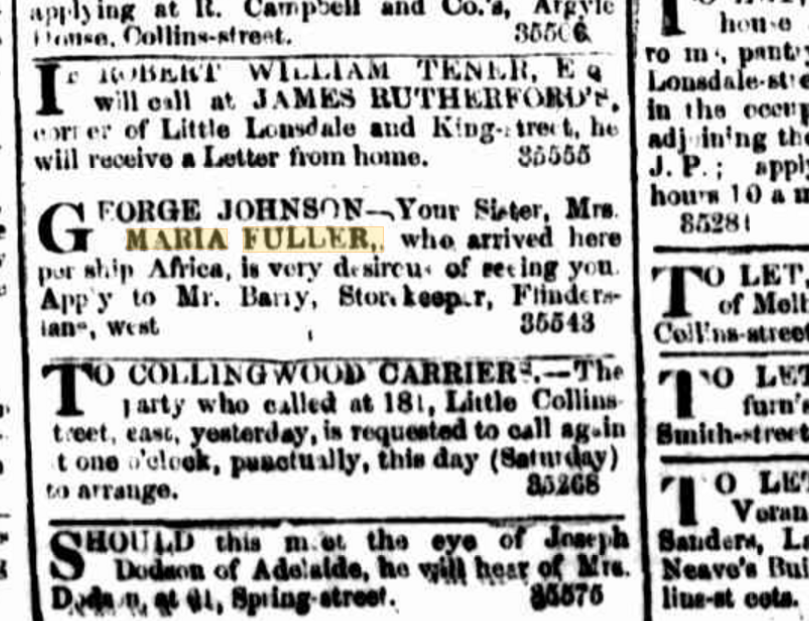
Anna Maria sent a desperate message to her brother George, who was supposed to have met them when they arrived. The following advertisement appeared in the Melbourne Argus on Saturday April 23, 1853.
GEORGE JOHNSON – Your sister MRS MARIA FULLER is very desirous of seeing you. Apply to Mr Barry, Storekeeper Flinders Lane, West.
That night when the destitute little family returned to their room, a big, sunburned man in his mid-twenties was waiting for them. Augusta watched as her mother ran into his arms. He was rugged looking and a little scary.
The man finally left Anna’s embrace, and looked down at the girls.
‘Hullo,’ he said. ‘I’m your Uncle George.’
He smelled of whisky. Augusta hid behind Amelia’s legs.
George was living in Ballarat, where the gold boom was in full cry. Augusta’s mother Anna was nothing if not resilient, and after a few years of living on the charity of her brother, she fell in love again. Henry William Cooper was the son of a coach builder from Dublin and owner of the Burrumbeet Hotel, on the shores of Lake Burrumbeet, near Ballarat.
Anna lied about her age to the celebrant, and most likely to her new husband as well. She was forty three years old by then, but the marriage certificate lists her age as just thirty-five. Partly, perhaps, for the vanity of her husband, who was thirty-seven at the time.
Augusta was twelve years old by then, almost certainly a flower girl. The ceremony took place on the north shore of Lake Burrumbeet, perhaps on one of those perfect spring days that Ballarat can produce when it feels like showing off.
George was there to give Anna away, and no doubt he did his best to drink the hotel dry at the reception afterwards. (The newspapers of the day were sprinkled with George’s minor run-ins with the law, mainly for drunk and disorderly behaviour and the odd fight.)
The wedding was a triumph, certainly much better than Anna’s taste in men deserved.
Within twelve months, however, Henry William Cooper was insolvent, and the Burrumbeet Hotel was sold for less than half of what he paid for it. In fact, a meeting of creditors was informed that Henry had paid three times the true value of the hotel in the first place.
Augusta and her sisters were again forced onto the charity of their family.
Continued next week.
The story of Charlie Gaunt is documented in the book, Whistler’s Bones by Greg Barron. The book is available from good bookstores and direct from the publisher at ozbookstore.com



 Stories of Oz