by Greg Barron
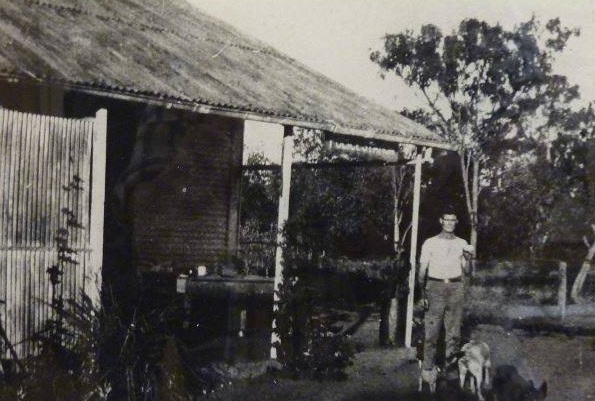
Mounted Constable Michael Donegan woke up in his cot at the Roper Bar Police Station, with a hangover so bad he’d been dreaming that he was back home in Derry, Ireland, where a huge shirtless man was hitting the side of his head with a ten-pound hammer.
His sleeping mind had wandered back to a dark little factory terrace, with Da putting on his boots before leaving for work, while oat porridge bubbled on the stove. The man with the hammer was Da’s supervisor in the foundry where he worked. Michael had always been frightened of him.
But the walls, revealed in the light of dawn, were not the whitewashed brick of home, but split raw timbers. The air was hot and humid, and the pillow damp from sweat. Michael Donegan realised that the terrace house, and the man with the hammer, were ten thousand miles away, and that the blows were coming from inside his own head, heavy from the whisky he had drunk the night before. He and some travellers: brumby runners, ringers, prospectors and a couple of government men had been playing poker, with a dram all round each time the cards were dealt.
As the local officer of the law, Donegan presided over a huge part of the Gulf, an area larger than all the counties of his native Ireland put together. This was no easy task. The Gulf was a refuge for the lawless, the adventurous, and the uncivilised. Many of the inhabitants had outstanding warrants. Others were hurrying to goldfields near Pine Creek and the Kimberley, some to dig for gold, others for the opportunities that gold might bring them.
For a while he lay in bed, letting his aches subside a little, going over the day to come. It was a Sunday, and thus he was perfectly entitled to spend it as he pleased. With luck, no lawless ruffians would ride into town. No one would be speared or shot. No one would be taken by a ‘gator, steal, or fight.
Donegan hoped for a quiet day. The afternoon, he decided, might be passed reading the bible on the riverbank, fulfilling the promise he had made to his Ma to keep the faith of his forefathers. It was also a good way to avoid the heat of the day, just far enough from the water to be safe from ‘gators.
He had managed to get out of bed, pull on a pair of trousers, collect the bowl of shaving water placed for him by one of the Ngalakgan girls who tended the house, and was half way through shaving when he heard a couple of horses ridden hard, coming into the station.
Donegan paused, razor in hand. Please God, he prayed silently, let them ride on, for pity’s sake.
Unfortunately, whoever it was reined in on the road outside. Two riders, at least. Next came raised voices, followed by a pounding on the door. Donegan lay still, scarcely breathing, hoping the sound would stop. Instead it came again, louder than before.
‘Ye can just bally well wait,’ he muttered to himself. This was a thankless job, he decided, being liable to be called upon at just about any hour of the day or night for anything from a murder, a complaint of violence against or by any of three or four local Aboriginal nations, or simply to help get a message south. Today, having planned a day of rest and peace, he was in no mood to be hurried.
The knocking resumed, harder than before, along with a few curses in a woman’s voice. The choice of words was not lady-like.
Wondering what in the name of the Saviour had turned up on his door Michael Donegan wiped his face clean with a towel, buttoned on a shirt and walked towards the door. His head thumped in time with each footstep.
A woman stood in the doorway, wild with unkempt hair, dirt and anger. At her waist was strapped a revolver seemingly too big for her to carry, yet she managed it somehow.
‘It’s about bleedin’ time,’ she said, ‘I’ve a ridden two hundred mile to get here, and it aren’t nice to be kept waiting at the door.’
Peering past her, Donegan perceived a man: a thin, shifty, nervous looking type who would not have looked out of place as a Derry pickpocket.
‘So what is troubling ye enough to ride two hundred miles?’ Donegan asked.
‘Let us in,’ said the woman, ‘yer slow-witted Irishman, and you’ll learn our business soon enough.’
‘Well I might. Just tell me what ye want first.’
‘Me and this old cock – me husband Tommy here – want a divorce.’
Donegan had been approached for all kinds of assistance in his months at Roper Bar, but this was a first. ‘Jaysus woman, on what grounds?’
The woman grinned slyly. ‘See here, Tommy can no longer do his job as a man.’ With those words she marched past a surprised Donegan and inside.
Her husband stopped beside the policeman. ‘What me wife just said aren’t true. She’s happened to find another feller on the Barkly, better lookin’ and richer than me, and he’s even gonna pay me for her. That’s why we need a divorce, so they can get hitched straight up.’
Donegan glared at her. ‘T’at’s irregular, I warn ye both …’
The woman pushed her face close to his, missing teeth and bad breath and all. ‘Listen you. Tommy’s in a hurry for his cash, and I’m in a hurry for me new man. So jus’ divorce the pair of us an’ we’ll be outta your way.’
‘Bless you, woman, but will you let me put a word in? I can’t divorce ye.’
‘Why not?’
‘Because I don’t have t’power. I’m a mounted constable, not a magistrate. Besides, ye have to engage yerselves a solicitor, that’s how t’e law works.’
The woman pulled the revolver from her belt and pointed it at the terrified husband, eyes still on the policeman. ‘Hark now to me you daft little bastard. Divorce us now or I’ll shoot poor Tommy right here on yer floor.’
Donegan placed a hand on either side of his aching skull, then looked upwards, as if praying, but all he could see was the python that had recently taken up residence in the rafters. ‘Put t’at damned gun away before I confiscate it for good and all.’ He reached out to grab her, but she skipped out of reach.
The woman climbed atop a chair and sighted her weapon at the terrified Tommy, who dropped down behind a desk.
Donegan walked towards the woman, crooning softly in his brogue. ‘Now, now, put the gun away, and let’s talk about this.’
Eyes wild, the woman fired the revolver in the general direction of her husband, leaving a slug embedded deep in the slab wall.
‘That’s it,’ shouted Donegan, ears ringing. ‘I’m going to arrest ye. Madwoman!’
Jumping down from her perch, with a wild cry, the woman took to her heels, running out the back door and into a stout little outhouse behind the main building. Behind it were the three separate cell blocks – solid, windowless sheds made of split timber.
Donegan and Tommy, along with a station dog – a dingo crossed with a kangaroo dog called Kip – all hurried out after her.
‘Divorce me and Tommy right now,’ the voice screeched from behind the door of the outhouse, ‘or I’ll kill myself. I swear I will.’ Then followed the sound of the inner lock being slipped home.
‘I told ye already,’ Donegan spluttered. ‘I cannot divorce ye. I’ll swear on the bible to t’at effect. It just cannot be done. Not by me. Not here.’
The woman began to cry, high pitched wails followed by deep throaty grunts as she searched for air. ‘I just want me new bloke, ah fer Chrissake, can’t you see? Tommy’s a useless damn wretch, and never done me a moment’s good in his life. I’ll kill meself, I swear it. Just divorce us, even if it aren’t proper. I’m gonna count to ten …’
Donegan walked to the side of the stricken husband. ‘Do you reckon she’ll do it?’
‘There aren’t no tellin’ what she’ll do when she gets like this.’
Donegan walked to the door and rattled it. ‘Unlatch t’at door right now. T’is exact second.’
More sobbing then ‘… Four, five …’
Head feeling as if it was about to explode, Donegan walked to the woodheap where the axe was stuck blade-first in a stump. At first it resisted his efforts to pull it out. He kicked it with his foot, and out it came. He hefted it by the handle. He pushed past Tommy, who was ineffectually trying to open the outhouse door, then took a mighty swing at the upper hinge.
‘ … Nine, ten …’
A terrific scream as Donegan struck the other hinge and the door fell inwards.
‘Yerve killed me you stupid Irish bastard, I’ll get meself a lawyer alright …’ she cried. ‘An’ I’ll see you hung like a dog.’
Dropping the axe and throwing the door aside, Donegan marched in. He grabbed the woman by the arm, and removed the revolver with his free hand.
In an instant, her demeanour changed. She went limp, and leaned back against him, fluttered her eyelids and looking up at him admiringly. ‘Oh, you’re very strong,’ she said.
The change totally disarmed him. ‘Why, t’ank you.’
She pressed a little closer to him. ‘Mister Policeman, I declare that you never even asked me my name. What kind of policeman doesn’t ask names?’
Donegan shrugged. ‘What’s ye name then, lass?’
‘Esther, it is. Now is that a pretty name or is it not?’
‘Well I don’t know. To me it’s just a name as like any other.’
The woman curled her hand around his bicep. ‘Now, would you please get on and divorce me and Tommy, and I’ll give you a gift you won’t forget in a hurry.’
‘What gift?’
The woman poked out a furred tongue, and lolled it around her lips.
Donegan was horrified. ‘T’at’s it,’ he cried. ‘I’ll divorce ye. But only if you promise never t’a come near to me again as long as I live.’
‘And you’ll give me back my revolver?’
‘I suppose so, yes.’
Marching the unhappy couple back inside, followed by the dog, Michael lined them up in the office, then fetched two trackers from their hut to witness the transaction. Opening a copy of the ‘Laws of the Colony of South Australia’ he found the section on divorce, and read out the Act from start to finish.
About one-third of the way through, Esther yelled out, ‘Do yer really have to read all that guff?’
Donegan took a perverse pleasure in making her wait. ‘I do, now be silent or it will only take longer.’ When he had finished reading, he decided that he needed some kind of pronouncement. ‘I declare, ye Esther, an’ Tommy, divorced, an’ t’erefore free of any encumbrance. Now get t’ hell out of my police station an’ never come back.’
But Esther was too smart for that. ‘Put it in writing, copper. I’m not going ‘til you do.’
He stared at her, close to exploding, ‘I have no right t’ divorce you. Let alone write it down. Can you even read lass?’
‘I can’t read a word, and neither can Tommy, but me new ‘usband can. He wants to see evidence of me divorce.’
‘Very well t’en,’ Michael scowled, sitting down behind the desk and taking up a sheet of stationery. On the top, the coat of arms of South Australia was embossed in gold. With quill and ink he wrote the words carefully, pressing hard on his quill as was his habit, despite the attempts of many a nun to cure him of doing so. When he was done with the note he signed it with a flourish. Esther snatched the paper off the desk.
‘At last,’ she said, ‘now give me back my gun.’
Donegan gave her the weapon. ‘Please be careful wit’ it.’
The woman grinned with a mouthful of brown teeth at him, and was out the door like a shot. Tommy smiled, and shook Donegan’s hand. ‘Good luck sir. An’ I can’t believe I’m free of her at last.’
Donegan grinned, ‘I can’t believe that I’m free of her either.’
When they were both gone, Donegan shouted to the cook for a cup of tea and sat down at his desk. He was feeling more than a little pleased with himself. When he looked down at his notepad he could still see the impression of the note he had written for Esther.
This is to certify that any man who marries this woman is insane and will regret his folly every day, for the rest of his life.
Signed
M.C. Michael Donegan
Browse books by this author at storiesofoz.com



 Stories of Oz