
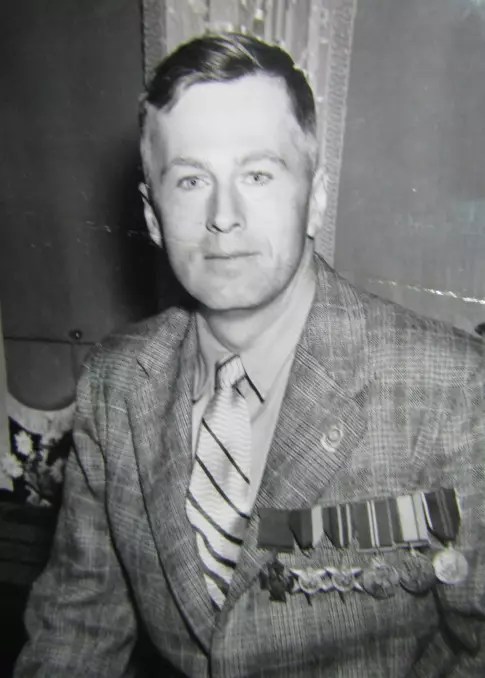
by Greg Barron
Of all the men who were compelled, by Government decree, to carry a rifle for Australia against the Japanese when they advanced down through the Pacific in World War Two, one man stands out.
They said that conscripts couldn’t fight. They said that conscripts weren’t brave. They called them chocolate soldiers, who would melt in the sun. On the 24th of July 1945, on the island of Bougainville, Frank Partridge proved them wrong, with a bravery that defined heroism for a generation.
Frank John Partridge was born in Grafton in November 1924, before moving with his family further south, to a hilly selection in a forested valley at Tewinga. The property was watered by a small waterway called Newee Creek, which ran roughly south before joining the Nambucca River near Macksville, in coastal New South Wales.
Frank’s father, Paddy Partridge, a World War One veteran from Kempsey, had met his English wife Mary in England while on leave in 1917. They were married in Islington the same year, then returned to Australia, and a rough bush life. Their first child, Kathleen, lived for only one year before she died. Their eldest son Robert was born in 1922, and Frank in 1924.
Life on the land was tough. Banana farming involved constant physical work, and, as they also ran a small dairy herd, the whole family all had to pitch in to keep things running. Frank attended the nearby Tewinga School only until his thirteenth birthday, when he quit to work full time on the farm. He was well-suited to the role: tough in body and mind, with an amazing ability to learn and retain facts.
In 1939, when war broke out, Frank was not quite fifteen years old, already broad and solid. Like most youths his age, he dreamed of following older brothers and friends away to the war, but he was also committed to his family. Mary’s two brothers had died in the first war, and she prayed that this conflict would be over before she lost her sons.
When Frank turned eighteen, conscription papers from a desperate country arrived. At that time the Japanese Imperial Forces were swarming southwards, and New Guinea looked like it would fall at any time.
Frank’s service record begins with his enlistment on 26th March 1943 in Macksville. After basic training he was posted to the 8th Infantry Battalion which was made up mainly of Victorian Country Lads. Dependable, hard-working Frank Partridge fitted in well.
After a stint in Darwin the battalion was shipped across to Queensland where training for overseas service took place in the Atherton Tablelands. Their first overseas posting was to Emirau Island, in the Bismarck Archipelago, where handpicked members of the battalion joined night raids in American PT boats.
In 1945 the battalion were shifted to the Bougainville Campaign, where entrenched Japanese troops were putting up fierce resistance on the Bonis peninsula, in the island’s north.
Frank was a member of a patrol that were engaged by Japanese machine gun units in a fortified position known as Base 5. The Australian counterattack faltered under heavy machine gun fire, with terrible casualties. Frank decided that it was time to act; to protect his pinned-down mates and bring the action to a close.
Laying down his rifle, Frank grabbed a couple of grenades and stood up, drawing the enemy’s attention by yelling at them to ‘Come out and fight!’ He rushed the nearest bunker under heavy fire, sustaining bullet wounds to the thigh, and left arm. Still, he managed to lob at least one grenade through the firing slit, then collect a Bren gun from a fallen mate and use it to finish clearing the position. When the Bren’s magazine was empty one Japanese soldier still remained, and the pair began a desperate hand-to-hand struggle. Frank drew the hunting knife he always carried and used it to deadly effect.
According to some reports, Frank snatched up a loaded ‘woodpecker,’ a Japanese medium machine gun, before continuing his charge towards a second bunker. Whether this is true or not, there’s no doubt that Frank, bleeding copiously from his wounds, left the first bunker and had begun an attack on the second when he collapsed from loss of blood. The brave attack was enough to save his mates from murderous machine gun fire and they quickly followed up the advantage gained.
Back on the farm after the war, still a very young man, Frank enjoyed several trips to England, once with a group of other VC recipients, then again for Queen Elizabeth’s coronation. After long days on the farm, he would his evenings absorbing facts from the Encyclopedia Britannia series that sat on the shelves.
Frank’s mother Mary died in 1960, leaving a quiet farmhouse, with only Frank and his father in permanent residence. Frank’s older brother, Robert, was a regular visitor, whenever he was home from the remote hardwood forests of the area, where he worked as a timber cutter.
In the early sixties Frank applied for, and was accepted, as a contestant on Bob Dyer’s Pick-a-Box TV show, going on to become a viewer favourite, with a national following, and winning more than £12 000 worth of prizes.
In February 1963 Frank married Sydney nurse Barbara Dunlop, at St Stephen’s Presbyterian Church. The engagement ring was a diamond cluster he had won on Pick-a-Box and their honeymoon was a cruise to America he had obtained in the same way. Barbara became pregnant with their child. Frank started building a five-bedroom home near Bowraville while she remained in Turramurra with her family.
Frank Partridge wasn’t perfect. At this stage of his life, according to some sources, he developed views on racial purity that were considered extreme, even for those times. Those views appear to have prevented him from pursuing the political career that he would have otherwise been well-suited to. He was overlooked for preselection as a Country Party candidate for the seat of Cowper in 1963.
Less than a year after his marriage, Frank was driving on the winding Bellingen-Thora Road when his Volkswagen struck a log truck driven by Dorrigo resident Herb Barton head on. The coroner, after considering police reports that included photographs of skid marks, found that Partridge’s car was on the wrong side of the road, and that the truck had braked to the point of being almost stationary when the accident occurred.
Frank’s bride of scarcely a year was left to grieve, and care for their three-month-old son Lachlan alone. The nation could only share that grief, and wonder how a road accident so easily killed a man who had charged through a hail of bullets to save his mates.
© 2023 Written and researched by Greg Barron
Check out more at ozbookstore.com
 Stories of Oz