Fights and Battles

  • Frank Partridge, VC

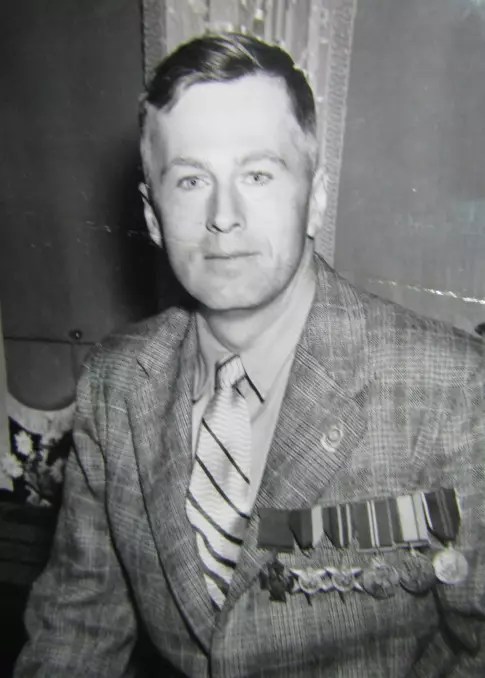
    Frank Partridge, VC

    by Greg Barron

    Of all the men who were compelled, by Government decree, to carry a rifle for Australia against the Japanese when they advanced down through the Pacific in World War Two, one man stands out.

    They said that conscripts couldn’t fight. They said that conscripts weren’t brave. They called them chocolate soldiers, who would melt in the sun. On the 24th of July 1945, on the island of Bougainville, Frank Partridge proved them wrong, with a bravery that defined heroism for a generation.

    Frank John Partridge was born in Grafton in November 1924, before moving with his family further south, to a hilly selection in a forested valley at Tewinga. The property was watered by a small waterway called Newee Creek, which ran roughly south before joining the Nambucca River near Macksville, in coastal New South Wales.

    Frank’s father, Paddy Partridge, a World War One veteran from Kempsey, had met his English wife Mary in England while on leave in 1917. They were married in Islington the same year, then returned to Australia, and a rough bush life. Their first child, Kathleen, lived for only one year before she died. Their eldest son Robert was born in 1922, and Frank in 1924.

    Life on the land was tough. Banana farming involved constant physical work, and, as they also ran a small dairy herd, the whole family all had to pitch in to keep things running. Frank attended the nearby Tewinga School only until his thirteenth birthday, when he quit to work full time on the farm. He was well-suited to the role: tough in body and mind, with an amazing ability to learn and retain facts.

    In 1939, when war broke out, Frank was not quite fifteen years old, already broad and solid. Like most youths his age, he dreamed of following older brothers and friends away to the war, but he was also committed to his family. Mary’s two brothers had died in the first war, and she prayed that this conflict would be over before she lost her sons.

    When Frank turned eighteen, conscription papers from a desperate country arrived. At that time the Japanese Imperial Forces were swarming southwards, and New Guinea looked like it would fall at any time.

    Frank’s service record begins with his enlistment on 26th March 1943 in Macksville. After basic training he was posted to the 8th Infantry Battalion which was made up mainly of Victorian Country Lads. Dependable, hard-working Frank Partridge fitted in well.

    After a stint in Darwin the battalion was shipped across to Queensland where training for overseas service took place in the Atherton Tablelands. Their first overseas posting was to Emirau Island, in the Bismarck Archipelago, where handpicked members of the battalion joined night raids in American PT boats.

    In 1945 the battalion were shifted to the Bougainville Campaign, where entrenched Japanese troops were putting up fierce resistance on the Bonis peninsula, in the island’s north.

    Frank was a member of a patrol that were engaged by Japanese machine gun units in a fortified position known as Base 5. The Australian counterattack faltered under heavy machine gun fire, with terrible casualties. Frank decided that it was time to act; to protect his pinned-down mates and bring the action to a close.

    Laying down his rifle, Frank grabbed a couple of grenades and stood up, drawing the enemy’s attention by yelling at them to ‘Come out and fight!’  He rushed the nearest bunker under heavy fire, sustaining bullet wounds to the thigh, and left arm. Still, he managed to lob at least one grenade through the firing slit, then collect a Bren gun from a fallen mate and use it to finish clearing the position.  When the Bren’s magazine was empty one Japanese soldier still remained, and the pair began a desperate hand-to-hand struggle. Frank drew the hunting knife he always carried and used it to deadly effect.

    According to some reports, Frank snatched up a loaded ‘woodpecker,’ a Japanese medium machine gun, before continuing his charge towards a second bunker. Whether this is true or not, there’s no doubt that Frank, bleeding copiously from his wounds, left the first bunker and had begun an attack on the second when he collapsed from loss of blood.  The brave attack was enough to save his mates from murderous machine gun fire and they quickly followed up the advantage gained.

    Back on the farm after the war, still a very young man, Frank enjoyed several trips to England, once with a group of other VC recipients, then again for Queen Elizabeth’s coronation. After long days on the farm, he would his evenings absorbing facts from the Encyclopedia Britannia series that sat on the shelves.

    Frank’s mother Mary died in 1960, leaving a quiet farmhouse, with only Frank and his father in permanent residence. Frank’s older brother, Robert, was a regular visitor, whenever he was home from the remote hardwood forests of the area, where he worked as a timber cutter.

    In the early sixties Frank applied for, and was accepted, as a contestant on Bob Dyer’s Pick-a-Box TV show, going on to become a viewer favourite, with a national following, and winning more than £12 000 worth of prizes.

    In February 1963 Frank married Sydney nurse Barbara Dunlop, at St Stephen’s Presbyterian Church. The engagement ring was a diamond cluster he had won on Pick-a-Box and their honeymoon was a cruise to America he had obtained in the same way. Barbara became pregnant with their child. Frank started building a five-bedroom home near Bowraville while she remained in Turramurra with her family.

    Frank Partridge wasn’t perfect. At this stage of his life, according to some sources, he developed views on racial purity that were considered extreme, even for those times. Those views appear to have prevented him from pursuing the political career that he would have otherwise been well-suited to. He was overlooked for preselection as a Country Party candidate for the seat of Cowper in 1963.

    Less than a year after his marriage, Frank was driving on the winding Bellingen-Thora Road when his Volkswagen struck a log truck driven by Dorrigo resident Herb Barton head on. The coroner, after considering police reports that included photographs of skid marks, found that Partridge’s car was on the wrong side of the road, and that the truck had braked to the point of being almost stationary when the accident occurred.

    Frank’s bride of scarcely a year was left to grieve, and care for their three-month-old son Lachlan alone. The nation could only share that grief, and wonder how a road accident so easily killed a man who had charged through a hail of bullets to save his mates.

    © 2023 Written and researched by Greg Barron

    Check out more at ozbookstore.com

  • The McGree Brothers of Taylor’s Arm

    badge

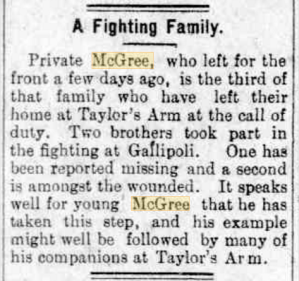
    John, Michael and Patrick McGree were raised on their parents’ farm on the Mid-north coast of NSW. All three answered the call to arms in 1915. The ANZAC battalions were forming up, and the brothers were determined to have their chance at glory.

    Their mother, Bridget Sullivan, had married Irishman James McGree in St Augustine’s Church, Longford, Tasmania in 1874. The young couple moved north and took up a selection on Hickey’s Creek near Kempsey. Life was tough, but like most good Catholics they welcomed children, bringing twelve boys and girls into the world over a twenty-five-year period.

    Patrick, the oldest of the three McGree boys who served, was a born adventurer. He headed off to New Zealand at an early age, living in Waiapo and Gisborne. He kept in touch with his Australian family via mail and occasional visits.

    In 1914, when war broke out, Patrick was 31 years old, yet he signed on with the Wellington Infantry, New Zealand Expeditionary Force. Michael crossed the Tasman Sea to join his brother, but was waylaid by an unscheduled love affair. He married his Kiwi girl, Nellie, just before heading off for intensive training in Egypt.

    John, still at home on the farm outside Taylors Arm, was 22 when he joined up in 1915. He was a small, wiry man, weighing just 58 kg, and of average height. In fact, none of the McGree boys were tall, but were all as tough as nails, with brilliant blue eyes and Irish charm. The doctor examining Michael for his enlistment described him as having a “grand constitution.”

    Patrick and Michael, though assigned to different units, both took their place amongst the bloody heroes of the ANZAC landings at Gallipoli. Both survived the early days of suicide charges on the well-entrenched Turks, but natural attrition took its toll. Patrick was killed on August 8, 1915, in the defence of a hill called Chunuk Bair.

    Nambucca and Bellinger New Fri Nov 26 1915

    Michael was wounded in the last days of the Gallipoli campaign, and was evacuated to the Fulham Military Hospital in England. His recuperation was slow, and he endured hospitalisation for almost six months before being returned to his unit, judged as fit to serve in the hellish trenches of France.

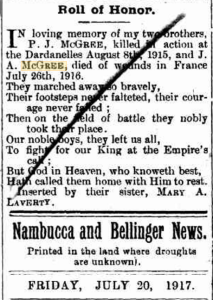
    On the 28th of July 1916 that “tough little bastard” John McGree was one of thousands sent in human waves against the German trenches at the Battle of the River Somme. He was shot in the chest and back. He was still alive when he reached the field hospital, but died within twenty-four-hours. He was buried at the nearby Warloy-Baillon Military Cemetery.

    McGree death

    James and Bridget received the usual telegram from Base Records in Melbourne informing them of John’s death: a message just fourteen words long. Losing one son was hard enough. The loss of a second must have been hard to bear.

    Bridget penned a desperate letter back to Base Records.

    McGree Bridget's Letter

    Dear Sir

    Please could you give me any information about the death of my son Pte John A McGree No. 3888, who died of wounds in France …  I would like to know the name of the hospital where he died, also if he was seriously wounded or what caused his death. What were his last words and where is he buried? Please send reply as soon as possible

    B. McGree,

    Taylor’s Arm, via Macksville

    Five months passed before she received any additional information: a kind letter informing her of the nature of John’s wounds and the name of the hospital and cemetery. John’s personal effects also arrived in the mail: one religious medallion, three handkerchiefs, two brushes, a cap comforter, one photograph and a notebook.

    McGree

    By July 1918, the surviving brother, Michael McGree, was a veteran of three years of the most terrible warfare mankind had ever known. On the morning of July 18, 1918, just months before the end of the war, his company were ordered to attack a fortified German trench at Gommecourt Wood, France. Running into a hail of lead, Michael was killed in action, just a few kilometres away from the site of his brother John’s death, two years earlier.

    Their father, James McGree died at the age of 86, in 1928. Bridget lived on until she was 87, a highly respected local pioneer, and a matriarch of the Laverty, Brock, and McGree families. She died in 1940 and was buried in Macksville cemetery.

    The strength she must have had to shoulder the grief of three lost sons is a testament to the spirit of not just the Anzacs, but their families.


    Written and Researched by Greg Barron

    This is an excerpt from Galloping Jones and other True Stories from Australia’s History by Greg Barron. Available at ozbookstore.com

    Click here to view the sources for this story.

  • James “Shearblade” Martin

    James Martin - Queensland Police Museum

    James Martin was working as a boundary rider when he first got his hands on a copy of Karl Marx’s Communist Manifesto.  He was thunderstruck by the possibilities. He carried the book everywhere while he absorbed every word. He then moved on to other socialist writers such as Bellamy and Nordeau.

    A dream was born, to make Australia a worker’s republic, owned by the people.

    In 1891, while shearing shed after shearing shed was burned to the ground by rampaging shearers, Martin hurried from town to town, enlisting recruits and trying to convince strike breakers to change sides. In Barcaldine he addressed a crowd where he announced that it was time to move against the Queen, who he referred to as “Old Mother Brown.”

    “What we want is a revolution and a republic,” he said. “If the amalgamated miners are prepared to back us, we are prepared to take the colony. I have a petition in my swag for electoral reform, but the only petition I believe in is 10,000 resolute bushmen behind 10,000 shear blades.” His numbers were not inflated. 8000 strikers were living in at least forty camps across Queensland, and thousands more were living independently or at home.

    Almost as furious about Martin’s disrespect to the Queen as his threat to conquer Queensland, a team of policemen were soon on the trail of the man now known as James “Shearblade” Martin. On the day of his arrest he was carrying a revolver and seventy cartridges. This fact did not impress the judge. He was sentenced to two years in prison for sedition, and taken to the dreaded St Helena Island, off the mouth of the Brisbane River. Known variously as “the hell hole of the Pacific” and “Queensland’s Inferno,” Martin served two years in that gaol, suffering mercilessly under the lash and terrible conditions.

    Released at the end of his sentence, Martin turned up in Charleville, taking control of the Australian Workers Union there, just in time for the next round of the Shearer’s Wars in 1894. He marched a small army to Winton, where the strike action was centred. Terrorising and converting scab labour was the number one activity, and Martin was involved in the burning of at least three woolsheds.

    This was harsh, but bear in mind that the pastoralists had again banded together to set shearers’ pay below what was considered a living wage. These men were fighting for the right of their families to eat.

    For the burning of the Ayrshire Downs woolshed Martin was ultimately charged with arson and sentenced to fifteen years at hard labour. They transported him on a steamer, padlocked to his bunk, to Townsville’s Stewart Creek Gaol, where he was placed in solitary confinement, in tropical heat, for three months. Later that year he was taken back to Brisbane’s Boggo Road, and ultimately to his old prison at Saint Helena Island, where he worked, for a time, as librarian, bootmaker, and cook.

    Petitioned for early release, by members of the original jury, and 1500 members of the public, Martin and his co-accused served only four and a half years.

    That was the end of James Martin’s dreams of a workers’ state in Australia. After his release he went to join the revolution in Paraguay, where his side had much better success than they did in Australia.


    Researched and written by Greg Barron.

    Click here to view the sources for the story.

    This is an excerpt from Galloping Jones and other True Stories from Australia’s History by Greg Barron. Available at ozbookstore.com

  • The Battle of the Margaret River


    In 1880, Australia’s borders were open, with no quarantine restrictions, and few immigration controls. Chinese miners had been flooding into the Territory goldfields for years. The Margaret River goldfields, north of Pine Creek, were worked by two rival Chinese factions, one from Hong Kong and the other, Macao. When they weren’t attacking each other with muzzle-loaders and shovels, they united against the Australian miners.

    In late August, 1880, a young digger by the name of Fred Stone asked a storekeeper called Ah See to look after a bag of his wash-dirt overnight to save him carrying it back to his claim. For some reason the request enraged the Chinese man, who responded by pushing the Australian out onto the track.

    Punches were thrown, and the furious storekeeper shouted for help from his countrymen, who came running from all directions. Picking up stones, they pelted Fred from all sides until he broke and ran. His Australian comrades, up at the camp, were greeted with the sight of their mate running flat out towards them, pursued by a mob of two hundred rock-throwing Chinese.

    What choice did the white diggers have? Filling their own pockets with rocks they rushed to their mate’s defence, pouring a highly accurate barrage of missiles down on the Chinese. Meanwhile, the only policeman within cooee, Constable Lucanus, ran back and forth trying to quell the riot. He eventually succeeded, but not before he too had been peppered with rocks in the body and legs.

    An eyewitness to the fight, a reporter from the Northern Territory Times and Gazette wrote:

    “Some of the incidents of the battle were amusing. One powerful young European came to the front and intended to throw stones in return, but he became a splendid object for the enemy; and instead of throwing, he found himself sufficiently occupied in avoiding the missiles. He admitted himself (that) it was a most unsatisfactory method of fighting.”

    The smallest white man there was apparently the best rock chucker, being described as a human Gatling Gun, causing carnage amongst the “enemy.” Not every man was armed with rocks: two diggers with rifles, and a local Aboriginal man called Billy Muck with his tomahawk, stood by, watching in case things got out of hand.

    In the end, five of the most violent of the Chinese were arrested, taken to the “shackle” and tried for affray. Within a few years the area was mainly worked out and abandoned. Interestingly, a portion of the Margaret River goldfields has recently been designated as a public fossicking area.

    Researched and written by Greg Barron.

    Click here to view the sources for the story.

    This is an excerpt from Galloping Jones and other True Stories from Australia’s History by Greg Barron. Available at ozbookstore.com