
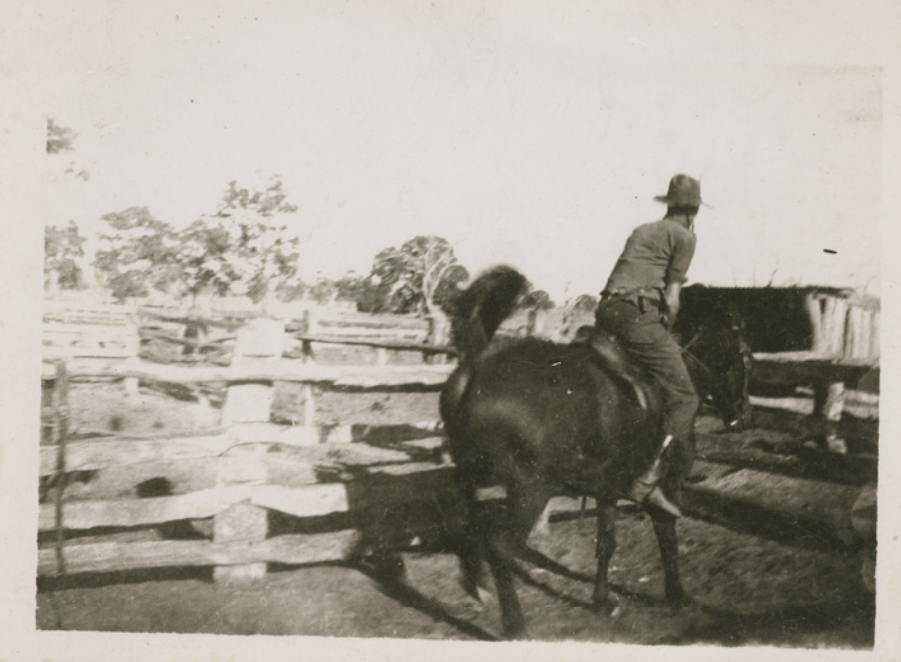
The Adventures of Will Jones by Greg Barron
When the Black-hearted Filly stopped trying to buck the saddle off, and slowed to a walk, Will followed patiently with the greenhide halter in his hands, whispering, cooing and even singing gentle songs. His pride was as bruised as his knees and elbows, but there was a glow in his eyes. For all his fourteen years he had dreamed of a horse such as this one.
The filly was listening; he could see her ears prick and move. Now and then she would stop, and look back at him with those big dark eyes before moving off again. Each time she walked more slowly, however, and travelled less far.
At length, after an hour of patient following, she allowed Will to restrain and lead her to the yards. These were solid and imposing, made of greying split posts and rails that had cost so much in splinters and sweat. Rectangular in shape, they were designed for sheep, not horses, but they would have to do. With the gate closed he untacked her, then fetched a pail of oats.
From then until sunset, he did not leave the yard. Yet he did not try to lunge her, or even lead her. Instead, he focussed on gaining her trust. He learned, in those first hours, that the filly did not like to be stroked, or scratched, not even on her withers or alongside her mane. Also, she was obsessively protective of her hindquarters. Approaching her from the rear made her kick or bolt.
The next morning Will continued to take things slowly. He led the filly around the property, taking her to meet the old farm gelding, who, it seemed, had been alone too long to make new friends. He introduced her to the sheds, the fields, then the rams and milk cows. Finally, he took her to the creek for a drink, noting how she started at anything unexpected, even a leaf floating on the current.
When they returned, he tried some of the tricks he had seen used by horse breakers who came and went from neighbouring farms, adapting the techniques to the gear and facilities at hand. Lainey came out and watched, that evening, as he lunged the filly, letting her run at the end of a long rope, in wide circles around his pivoting wrist. Both Will and his sister were in awe at the beauty of her movements, the flowing grace of that animal.
‘She’s a cracker, ain’t she?’ said Lainey.
Will flashed her a smile. He was already in love with that horse, obsessed with her. When he was not working the filly, he fed her grass from his hands, fetched clean water from the creek, and brushed her as much as she would permit. On warm nights he unrolled a swag beside the yards and slept there, sometimes waking at midnight to feel the falling dew, and see the filly watching him, nickering softly. Even when he slept, he dreamed of her, of galloping across some distant grassland. Waking was no disappointment, because she was there, and the learning, on both sides, continued. All this time the saddle sat in his room; oiled; spotless; waiting.
At school Will had no energy left to play up, for as well as training his new mount, he did a man’s labour around the farm, meaning that he often ate long after dark, his meal kept warm on a tin plate on the cast iron stove. His mother was always there to serve it up, and hug him tight when he seemed dispirited.
His father, never a man to show emotion, merely said encouraging things like, ‘That oss ain’t kilt yew jus’ yet, eh lad?’
She hadn’t of course, because he had not ridden her again, though he had intended to do so several times. Placing a foot in a stirrup was enough to cause her to rear. The slightest hint of his weight had her skittering sideways.
Horse breakers, in those days, did the rounds of districts, travelling from farm to farm, and that weekend, when Will heard there was a breaker in residence at a sheep station called Canyonvale, ten miles away, he saddled the farm gelding and rode him there.
The breaker was a man of about fifty years, with a small clay pipe that never left his mouth, and dark stains on the stumps of his teeth. Will watched him work in the round yard for two eye-opening hours and picked his brains over a quick lunch in the shade of an ironbark, in a paddock that smelled of sheep droppings, and crawled with flies.
‘Sounds like a rare ‘orse,’ said the breaker. ‘I seen plenty of natch’ral outlaws but now an’ then you see one that’s just sensitive, full a’heart and they buck cos they’re so high-strung they can’t help it. Such ‘orses need careful training. I struck one jes like yours once – ‘ated to be touched an’ all, but once she settled to the bit I swear she were the best ‘orse I ever knowed.’
‘Can you come an’ have a look at her for me?’ Will asked.
The breaker sighed, ‘I can’t lad, more’s the pity. I’m contracted for six ‘orses a week for old O’Shanahan an’ I’ve ‘ardly time to scratch meself. But here’s a minute’s worth of advice. I’ll tell you what I did with me ol’ mare Perse, an’ you could try too. I weared her out first. Walked her all hours, then started out with saddle-weights until she were too tired to buck.’
‘Saddle weights?’
‘That’s right, a little more each day until she gets used to it. Then really tire her out before backin’ ‘er for the first time. You see, ‘orses are a bit like boilers on a steam engine. Some are big and powerful an’ slow to steam up. Some get way too much pressure, too quick. You have to let some of that steam off, is all.’
When Will returned, after a thoughtful ride home, the filly seemed to have missed him, watching him incessantly with her huge eyes, even nuzzled under his arms, looking for treats. It didn’t take him long to put into effect the plan suggested by the breaker.
That afternoon, with his mother’s help, he sewed two flour bags together, and filled the space with about three stone worth of sand from the creek. This done, he tied it around the old farm saddle with a leather surcingle. After buckling this contrivance, over a saddle cloth, onto the filly, he walked her around the place for a couple of hours, then lunged her until dark. The next day he added another half-stone of sand, and did it all again. The one big advance, in those days, was that she would now let him stand with his weight on one stirrup, then the other, like he’d seen the breaker do a few days earlier.
The longer this went on, the more reluctant he became to actually mounting her again.
He was tacking the filly up one morning when he noticed his father sitting on the rails, watching him.
‘There lad,’ said Christian Jones. ‘Ah seen Abner Miles up in town afore. He reckons the month is up at the end a’ the week. He wants you to ride o’er there after breakfast on Saturday so ‘e can see youse ride the filly. If you does it alright the saddle is yours.’
‘What if he aren’t happy wif the ride?’ Will asked nervously.
‘If that was to ‘appen yew must give the saddle back.’
When his father strode away Will gave his horse a deep sideways look. The breaker at Canyonvale was pushing through six mounts a week, and he, Will, couldn’t finish one – after three weeks of trying – and she had apparently already been broke.
Will attached the horse’s burden, now seven stone in river sand, and led her off at a brisk walk. Growing impatient after a while, he broke into a jog. He didn’t care that he was darn near worn out himself, he just kept going, until he could see the sheen of sweat on her flanks.
After a good four or five miles of this, he lunged her for another hour, let her drink, then untied the sandbags and dropped them to the ground. When this was done, he fetched the new saddle from his room, along with a clean saddle cloth, bridle and bit. When she was tacked and ready he looked into her huge left eye.
‘Right,’ said Will. ‘You an’ me have learned to get along pretty well, but now yer goin’ to have to let me back yer. It aren’t so bad really, just about every other horse in the world has learned to let someone ride them. Why can’t you?’
The filly lifted her head a little, like a nod. That was enough encouragement for Will. He slipped his left boot into the stirrup, and swung his leg over. Then, without any pressure on the reins, he told her to walk, like he had a hundred times before, from the safety of the ground.
The filly took a few steps, stopped, then made a low groan that might have been resignation. Then, she settled into a crisp walk, around the perimeter of the yards, responding to Will’s gentle signals.
Feeling confident, Will took her out through the gate, heading down towards the corn fields. She was obviously nervous, but kept her composure, even when a wallaby started from the grass beside the track.
For almost an hour he rode her, and when he passed the house, he called out to the family, and they came out to clap and congratulate him. When he finally dismounted, Will was filled with elation, though he knew that this was only a start. It was one thing to sit on a horse and walk her around. Abner Miles would want to see a little more than that. He was still a long way from success.
All week he wore the filly out with the weight of river sand, then mounted up, still using the new saddle, so she could get used to it. Out in the paddocks and farm tracks he practiced bringing her up into a trot, turning and wheeling. She was learning to respond to even the subtlest signals.
It was a punishing schedule for Will as much as the horse, and on the one day he tried to mount her without working her hard first, she sucked back at first, and when he finally got her moving she bucked him off cold, leaving him picking up his hat and staring after her, shaking his head.
When Saturday morning came, Will rose before dawn and snuck out of the house. He caught the filly in the darkness, saddled her and added the weighted sack.
Then he led her out the drive, and onto the road. He led her into Grubben Creek, then back again twice, jogging all the way. He went inside for breakfast while she rested, and with the best wishes of his family ringing in his ears, he rode the filly to Abner Miles’s place.
Will had been there before, and knew the place well enough. He spotted Abner Miles and his farm hands, near the house yards, sitting on makeshift seats around a smoky fire. A freshly-shoed horse was standing nearby, while others waited for the same treatment in a small yard. Also present was a lad of about six years, dressed up as a miniature horseman, running wild around the camp.
‘By Jove! If it ain’t young Jones,’ Abner cried, standing up so abruptly he almost spilled his mug of tea. ‘‘An’ he’s riding the Black-hearted Filly. Well done lad, yer’ve tamed her.’
Will rode in close to the group, and dismounted with relief. He had got here on horseback, and had not been bucked off in front of these men. That was a good start, he reckoned.
‘She looks darned exhausted,’ said one of the men.
‘Well, she felt like a gallop,’ lied Will, ‘so that’s what we done.’ He paused and looked at Abner. ‘Well, Da reckoned that all I had to do was ride over here, to show you that I’ve finished breakin’ her, and I guess I’ve done just that.’
‘Well, you have done what I asked, a’course,’ said Abner. ‘But before the bet’s won, and the saddle’s yours, I’d like to see you ride a little more.’ He pointed to the flat stretch of paddock beside the yards. ‘How about a canter? Show us a few turns at speed. Maybe left and right, a fast stop. Then back her up.’
Will knew that all the blood left his face, because he could feel it go. He’d only had a few days to train her and was not confident of performing in front of these seasoned riders. He looked down into the eyes of the six-year-old boy, who was picking his nose and staring back. Moving his gaze to the ground, Will shuffled his feet a few times, then looked back at the owner. ‘Whatever you say, Mr Miles.’
Acting with a confidence he did not feel, Will mounted up and urged the filly out onto the stubbled ground of the paddock. Nudging her into a trot he did a wide loop that felt almost perfect. Everything was in rhythm, his backside rising and falling in accord with the gait.
Next, he edged his weight forward and felt her power as she accelerated, changing into the three-beat canter while he held the reins with soft hands. So far so good; the filly was behaving impeccably. She cantered, responded to heel and rein, turning left and right. After a few minutes of this he felt confident enough to try a trick he had only just started teaching her the previous day – leaning back and applying light pressure with the reins. In response she backed up so neatly he swelled with pride at how far she had come.
When he and the filly had done all that was asked, and more, Will rode back to the group of men, staying on the horse and looking down from the saddle. He felt on top of the world. He had, himself, tamed this amazing creature, and earned the beautiful saddle all on his own.
Abner Miles had just opened his mouth, no doubt to compliment Will on his effort, when the six-year-old lad decided that it might be interesting to approach the filly from the rear and pull like a bell-ringer on her admittedly beautiful tail.
The reaction was startling. Terrified by the sudden movement she could not see, and the pain of her pulled tail, the filly kicked backwards, then started forward, bucked once and tried to gallop away. By some miracle the lad who had caused this reaction, avoided having his skull split and scrambled to safety, bawling in fear.
After covering fifty yards the filly left the ground in a wild four-legged leap, and Will, who had been clinging on with some success, fell down her near side, in complete disbelief at this change in circumstance.
All might have been well, if his foot had not tangled in the stirrup, and his dragging body had not spooked the filly again. She ran, confused and terrified, like wind through a gully, the weight on one side causing her to run in a circle, dragging him back, almost adjacent to Abner Miles and his men.
As Will finally managed to pull his foot from the stirrup, the spectators were laughing fit to bust.
He came to his feet at last, near tears, skin off his elbows and the arse torn from his pants, shuffling, embarrassed while the filly stopped nearby, looking hurtfully back at the group.
‘I s’spose I ‘ave to give that saddle back now,’ Will said.
Abner Miles came to clap him on the shoulder. ‘No lad, you gave us the best laugh I’ve had a bloody donkey’s years. It’s yours. Our saddler’s only just starting up makin’ what he reckons are special Australian stock saddles – it’s what ‘e calls a practice go.’
‘Thank you, sir, you’re very kind.’
With his pride at stake, Will had no intention of leaving that place on foot. He caught the filly, straightened the saddle, climbed aboard and rode off at a walk, still sore, but aware that he was now the owner of a horse and saddle that could take him anywhere he wanted to go.
© 2026 Greg Barron
Photo courtesy State Library of South Australia
New Chapter soon …
 Stories of Oz
We’d love to hear your thoughts on this post!