
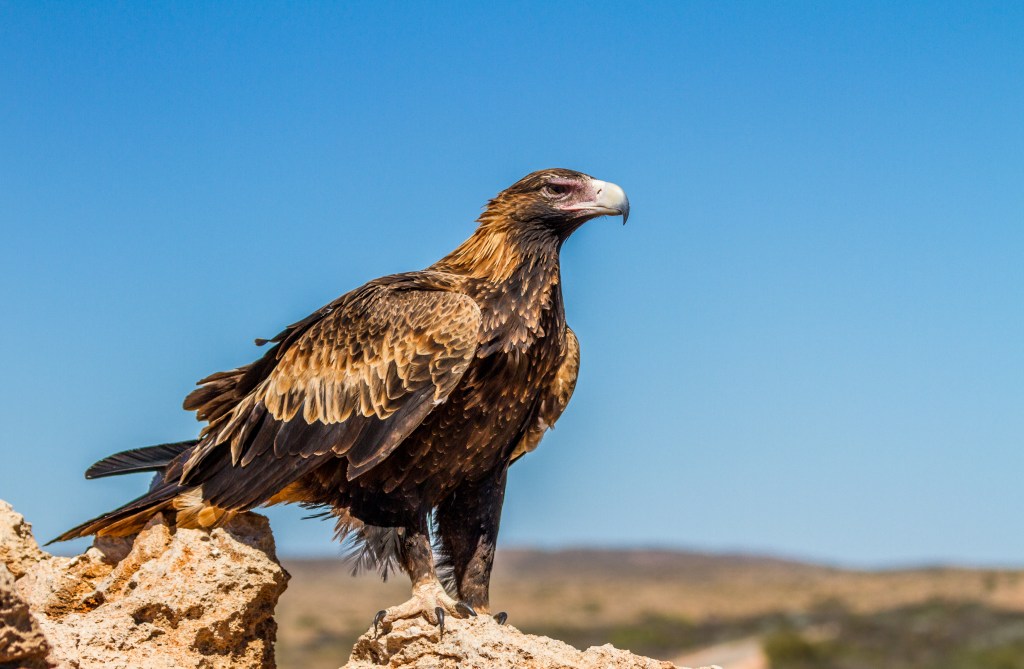
Two years earlier, a wedge-tailed eagle had flown from his Bluff Mountain eyrie, and sailed over the Warrumbungles and the surrounding plains. From that height, he had watched Will Jones, Fat Sam, Gamilaroi Jim and Lainey ride north, pursued by a relentless contingent of New South Wales police, with their trackers and Winchester rifles.
Now, two thousand miles away, his distant, northern relative was aloft over the Barkly. Larger than her male cousin, with darker plumage, her flight, on wings mottled brown and black, seemed effortless. Her hooked, white beak was strong enough to bite through the spine of a kangaroo.
The eagle floated on the warm air, holding station over the earth, watching for opportunity, roving her domain, from coolabah and bluebush swamps to the high downs country – the gravelly ridges, broad plains, and the new, green pick on the dark expanses where dry-season fires had burned their way through.
She knew every waterhole along the Ranken and Playford, had raised clutches in many sites along these rivers. Her mate was back with the nest even now, protecting the young chicks. They were close to fledging, and endlessly hungry.
There were humans too, in the vast tablelands. A camp of Wambaya people, well hidden in the coolabah scrub west of the Ranken, their fires smoking and the smell of cooked meat from the previous day’s hunt wafting up to her nostrils.
Soon afterwards, she saw a gathering of mostly white men on a bend of the Ranken, with pale figures leaving and arriving, noisy chatter and the stamp of horses. Three riders were headed east, and she shadowed them for a time, before peeling off towards the north.
Finally, at the furthest point of her flight, she came to a hill of ribbon stone, in the highest crags of which she had once built a nest. There were humans here too, and she watched a file of riders, horses, and one camel leave their campsite beside the hill and head away, into the black soil plains. She noted, however, that the cameleer and his family remained behind. They had stayed in that place before – she had seen them many times over the years.
Of most interest to the eagle was a nearby mound of loose stones, and as she circled low to investigate, she caught the smell of meat – a large, freshly dead animal. The trees nearby were haunted by waiting ravens, and a whistling kite took to the air as she approached. Talons extended, she landed gracefully on the cairn – taking possession of it – her huge wings braking her landing.
There was meat here, yes, but the eagle understood that she would be unable to penetrate the stones that surrounded it. She would have to wait until the pack of dingoes that patrolled the area found the scent and moved some of the rocks, opening the way. Then there would be a feast for all.
The eagle flapped her wings and returned to the air, prepared to wait, taking a last glimpse at the line of men and horses, as they disappeared towards the Playford River and Alexandria Station.
***
Two hundred miles to the northwest, in the hard-to-reach country between the Hodgson and the Cox rivers, two men were riding fast on a narrow trail through lancewood scrub, avoiding the hard and dangerous branches with difficulty. The rhythm of the hooves was transmitted by the shock of each footfall, and the riders made their bodies fluid, moving with the energy of their mounts.
Rafe Williamson was in the lead, riding with both natural skill and long experience. Behind him came young Matt Power. A branch struck Rafe’s shoulder and snapped, filling the air with the violet-sweet smell of fresh sap. He pivoted easily, avoiding the next hazard, then sped into the clear. Rafe was the wrong side of fifty, but he could still match it with the youngsters.
The two men were laughing, enjoying the chase, splashing through the occasional puddle on the track, splattered with mud to the knees. The horses too, seemed to enjoy the hunt. Fresh from rest and good feed, their energy seemed boundless.
The brumbies came to a rise – a scrubby hill – and they did not hesitate, taking it at the gallop. They slowed on the way up, but there was no room to come alongside to rope them. The brumbies continued uphill, and every sense and muscle went into the chase.
They reached the summit, fighting hard, the first flecks of foam flying from the bit of Rafe’s gelding. The hill shelved onto a flat top, and the scrub gave way to rock and grass. It was dangerous ground at that speed, but the chase did not slacken.
Down the other side they went, so thrilling, frightening and fast that Rafe let out a yell. It was on such ground that good horses showed their mettle, almost supernatural in the way they found their footing and stayed upright.
At the bottom, back into the scrub, they intersected a track. It was there that something unexpected happened. Two horseman came from nowhere, on an intersecting angle, cutting the two brumbies out, and becoming frontrunners in the chase.
‘Hoi there,’ shouted Rafe. But the men did not turn.
The newcomers had fresh horses, and the brumbies were blown. They galloped after them, then turned and guided them expertly into a clearing. Each man roped one of the brumbies, using his own mount to brake and contain them while they reared and kicked.
Rafe followed, slowing his gelding to a walk, and moving into the clearing, the adrenalin in his system turning to bitter acid. He saw that one of the two men was Ted Coombes, son of the Victorian cattle king himself, now manager of the adjoining Bundarra Station. He was tall and broad-shouldered, and the quality of his garb stood out – a glossy black shirt, embroidered around the pockets, new moleskins and ‘lastic sided Chelsea boots.
Rafe’s blood boiled, and his fist curled as he rode up. ‘They’re my bloody horses. They come from my run.’
Coombes smirked, ‘Well, I don’t see no brand on them. They’re on my place now, and our ropes are ‘round their necks.’
These words gave Rafe pause. They had crossed the bed of Whiteclay Creek a good mile back, and the boundary slewed across the bends and loops of that waterway.
Coombes had not finished, but he broke off to control another determined run from the brumby he had roped, before continuing. ‘Besides, this whole damned run will be ours in five days – Hemlock Downs as well. The court in Palmerston has given you until the nineteenth of December to produce your damned evidence, and we both know that’s not gonna happen – that’s just four days from now.’
‘Oh, it will. I won’t be tricked into giving the place up,’ said Rafe.
Coombes made a face, like a petulant child. ‘We’ll see about that, but right now I suggest that you get off my family’s land.’
With a final smirk, and the two brumbies trailing from the ropes, he and the other horseman headed back the way they had come.
Rafe was silent and reflective as he idled his horse homewards, with Matt following at the same pace behind. Without speaking, they again climbed the hill they had so recently raced down. It was breezy at the top, but the view was spectacular. From that height they looked down on Bundarra Station, now owned by the Coombes Cattle Company.
A few months ago, the place had boasted just a few bark-clad buildings, but now that the Coombes family had moved in, there were prefabricated huts for the men and a homestead for the owner’s son, all being thrown up by a small army of labourers.
Rafe continued to watch, bitterness filling his heart. The Coombes company had bought up three stations, all around Hemlock Downs. This, his own run, was the key. Five hundred square miles. It had two perennial creeks, and broad waterholes that never dried up. It was the best finishing country in the area. Rafe knew how much old Howard Coombes wanted it.
There was no problem, however, until Rafe’s aunt, the Lady Beatrice, had fallen ill and died, back in Brisbane, at the age of seventy-three. Her death sparked a calamity he had not expected.
‘You alright boss?’ asked Matt.
‘Yeah, I’ll be fine. Let’s go.’
It was a two-hour ride back to the homestead, and an afternoon shower fell as they rode – not heavy rain, but enough to have them stowing matches and tobacco deep into their saddlebags, and making for a sombre ride. It had stopped by the time they reached the house yards, where the men were roping and branding horses. The yards were hewn of unshaped bush timber, but the makers had taken pride in their work.
The cattle work was finished for the year – the herds scattered across the grassy plains of the station, but these men did not have the luxury of rest. They’d used the time to chase brumbies, and yesterday they had caught a good number – eight mares and two male foals, still young enough to be gelded.
Harry Griffin walked across when they arrived. ‘No more horses?’
‘No mate, Ted bloody Coombes stole two from right under our noses. Bastard.’
There were five men working around the yards that day – three white and two black. All were lean from hard work, and there was humour in the way they worked and related with each other.
Rafe had been considering his options on the ride back, but in that instant, he made a decision. ‘I’m not waiting any longer,’ he said. ‘I’m gonna go and find this damned mail myself, even if I have to ride all night.’
‘I’ll come with you,’ said Matt. ‘It ain’t good to ride alone.’
Rafe looked at Tom. ‘Can you spare the young feller for a day or two?’
Harry was a Yorkshireman, and he did not mince words. ‘Aye, well, helpin’ you save t’e damned run is more important than anything ‘e could manage here.’
©2025 Greg Barron
Continued next Sunday
You can read this, and previous chapters on the website here: https://www.storiesofoz.com/category/will-jones-and-the-territory-mail/
Get previous Will Jones books, Will Jones and the Dead Man’s Letter, and Will Jones and the Blue Dog, here: https://ozbookstore.com/
 Stories of Oz
We’d love to hear your thoughts on this post!