
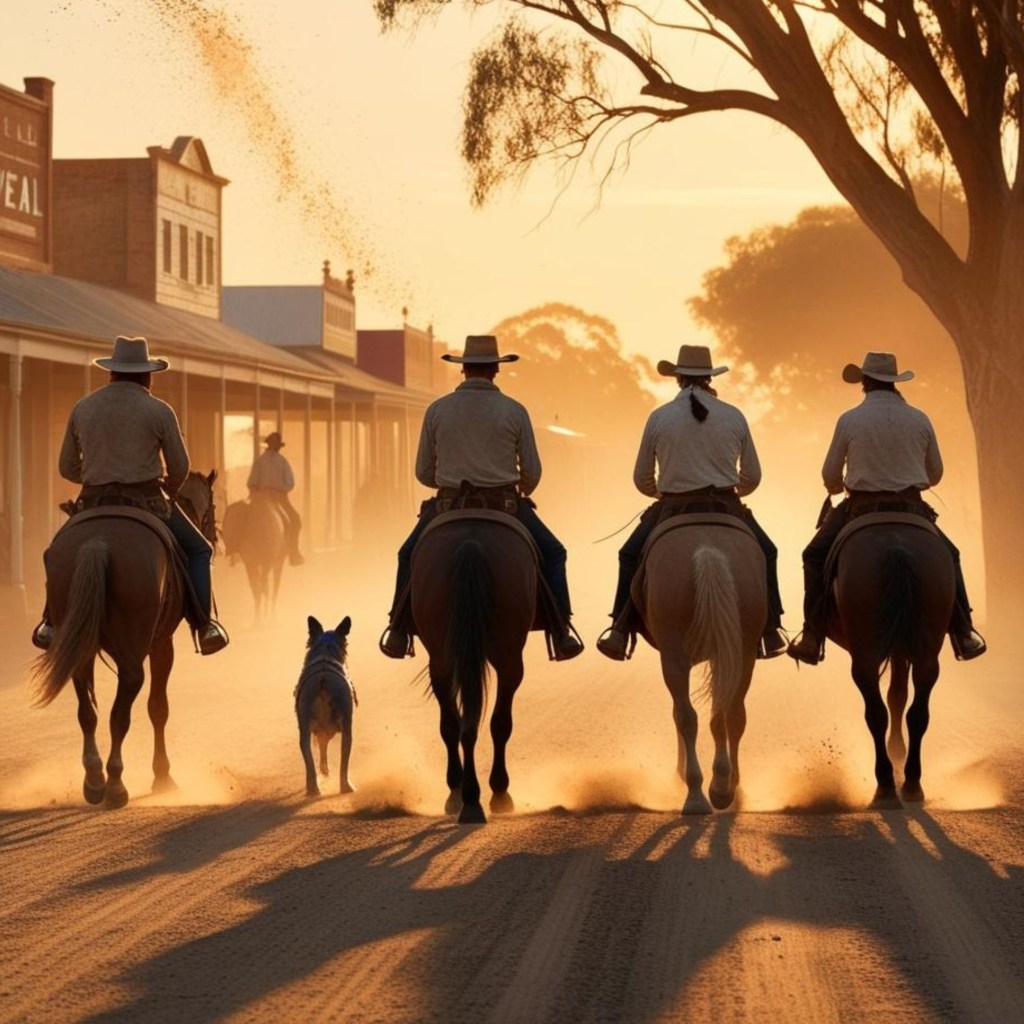
They looked like scarecrows in the saddle, riding out of the plains and into the township of Camooweal. It was the twentieth of December, 1887, and the combination of heat and humidity made the air so thick it could be cut into sections with a cross-cut saw. The riders were tired, road-weary, and exhausted. Even Gamilaroi Jim had stopped whistling – for the birds he liked to mimic lacked the energy to sing.
Will Jones came first, his eyes creased with tiny wrinkles after eight months of travelling under the Queensland sun. His cheeks were dark with heavy stubble, and his forehead shone with sweat. Behind him came Fat Sam and Lainey, then Jim in the rear, bare-chested as usual, trailed by two pack horses, the same number of spares, and one bony chestnut mare that had started following them a week or so back.
Little Blue, the cattle dog that ambled along on the road beside Will, had also lost condition. His head looked too big for his body, but he was young, tireless, and alert. His nostrils flared at the smells of the town ahead.
‘I told ya we’d reach Camooweal before Christmas,’ said Lainey, urging her mount into a trot, and coming up beside Will.
‘Well, you was right for once,’ Will conceded. A fly had lodged itself in the corner of his left eye. He removed it with his thumb and forefinger, before flicking it away to the ground. He’d been looking forward to Camooweal – the chance to pick up some work and provision themselves for the next stage – the Territory border was only a few miles away. There would be no spree, however, the little gang had scarcely a coin to spend between them. They had resources, in a safe place near Clermont, seven hundred miles to the southeast, but it was as useless to them here as shares in the Royal Mint.
As they entered the town, a gunshot sounded from up ahead, followed by the tinkle of breaking glass. Will stopped his horse and listened, then looked at the faces of his companions. Only Fat Sam gave nothing away. Jim raised an eyebrow and Lainey looked alarmed.
Another gunshot, and some distant laughter.
‘Jesus,’ Lainey said, ‘what in blazes is goin’ on?’
‘Fair question,’ said Will, ‘but we can’t let a bit a’ shootin’ spook us. We need work. We’re too skint for a bag of flour, and tea, an’ I ain’t had a lungful a’ smoke in three weeks.’
‘You think it’s been a picnic for me?’ hissed Lainey.
‘No one arksed you to come along – you’ve got a husband. You should go back to him.’
‘No fear,’ said she. ‘I’d rather get bit by a brown snake than wear meself out in a farmhouse raisin’ brats and cleanin’ dishes.’ She rolled her green eyes skywards. ‘Makin’ beds and sweepin’ floors like some kind of wretch. That ain’t me, dear brother, and well you know it.’
‘Well, stop ya bellyachin’.’ He lowered his voice. ‘And keep those bleedin’ curls of yours under yer hat, and yer chest sucked in – better if people think yer a man than have every hot-blooded cove in town chasin’ after you.’
The riders passed a saddler’s shop, and a smithy, from which a smell of smoke, slag and molten iron drifted, along with the clang of a hammer on metal. Further on they saw three men under the shade of a small and twisted coolabah tree in the middle of the street. They were stumbling around and calling out. All had revolvers, and appeared to be taking turns shooting at an empty whisky bottle – only a few paces away from them, nestled against the trunk of the tree.
An Irish voice rang out, ‘Ah, ye rotten beggars. My turn.’
There was another gunshot, but no shattering glass this time. A clean miss. The other two men guffawed. The sound, up close, was loud and startling. Will’s gelding nickered, then crow-hopped, and needed a moment to settle before moving on. The horses were all used to occasional gunfire, but they were thirsty and irritable. The merciless sun had evaporated all trace of the previous night’s rain. Not a puddle had remained by mid-morning, and the horses had not drunk since then.
Will spotted the public trough up ahead, on the left side of the street, past a general store and the post office. The horses could smell the water, but they were wary of the three drunks and their high-jinks, and needed urging to keep going.
‘Let’s get down the river and find a camp,’ Lainey said. ‘Then come back when these mongrels have gone.’
‘No, bugger it,’ said Will, ‘I won’t run from a few drunken cows under a tree.’
As if by agreement, the four of them bunched in together, and rode close to the buildings. The oppressive heat seemed to magnify.
‘Where’s the law in this barsted town, anyway?’ Will asked.
‘That’s funny,’ whispered Lainey. ‘I ain’t ever heard you wish there was a walloper around in your life.’
‘Well, people don’t generally start blastin’ away at bottles in the middle of a town, neither.’
Reaching the trough, Will dismounted, followed by the others. The activity captured the attention of one of the men under the tree, who walked out of the shade, holding his pistol at his side, staring as they allowed the horses to drink.
Little Blue was close against Will’s legs, hackles up, a growl emanating from deep in his chest. The dog, Will had found, was a reliable judge of human character.
‘What’s this bally turnout?’ shouted the gunman in a strong Irish accent, turning to his mates. ‘You never know what’s gonna roid in off the track, do ye? Now we’ve got a Chinaman, a myall, a pretty youth too young t’shave, an’ a wild-lookin’ white man.’ The other two, swigging from bottles in the shade, laughed. Addressing Will, the Irishman went on, ‘Strange company, ye’re keeping t’ere, sonny, wouldn’t ye t’ink?’
Quick as a whip, Will reached up and plucked his rifle out of its scabbard with his left hand, transferred it to his right, then worked the lever in one smooth motion. It was a new .44 calibre Winchester repeater, purchased in Winton with some of the proceeds of the Blue Dog gold mine. It was a top-shelf weapon, and Will’s pride and joy.
‘Oooh,’ came the Irish voice, ‘we’ve got a foisty one, have we? Well an’ all, don’t make t’mistake of startin’ a foight.’
Will wanted to say that he had just seen the Irishman miss a bottle at five paces, and that, if it came to the crunch, he could probably shoot all three of them with the Winchester before they got close enough to be sure of their aim with their revolvers, but he kept his mouth shut.
By then Fat Sam had his Snider out, and Jim had grabbed the Henry repeater he had, more than a year earlier, ‘borrowed’ from the New South Wales constabulary. The latter weapon, Will was aware, had just two cartridges remaining, for they were difficult to find. But even so, this was a considerable armoury compared to three revolvers. The Irishman stared for another moment or two, then roared with laughter, and took a huge swig from the bottle in his left hand, as if ignoring them of his own accord – not because he was out-gunned.
‘Bugger it all Will,’ hissed Lainey. ‘We’ve only been in town five minutes and you’re tryin’ to get in a shootout with a bunch of armed inebriates.’
‘Settle down, we’re just showin’ them that we’re not easy game. I agree that gettin’ out of here’s a smart move, but we got things to do first. If Jim and Sam can stay here and watch the horses, you could dart into the store and try to get credit for some flour, tea and tobacco.’
‘Fat chance of that – we just blew into town lookin’ like beggars,’ Lainey opined.
‘It’s worth a try. We need to eat – and there’s barely two days’ worth of flour left.’
‘Yeah, orright. I’ll give it a go.’
‘There’s another store across the road – and a pub with it – I’ll duck in there and ask if there’s any work around.’
‘Don’t stay there all blasted day,’ warned Lainey.
‘I wish I bloody could,’ he said.
Still carrying his rifle, Will strode away across the street, with Little Blue keeping hard beside his calf. Passing the tree, he studied the three drinkers closely. The Irishman was well into middle age, with sandy hair and a bald spot in the middle. He wore filthy dungarees, a collared shirt, and suspenders. He had rough moustaches and a fleshy face, and was missing several teeth. The second man was young, barely twenty, but with a wooden look. He was big in the shoulders and neck. A follower, Will decided.
The furthest back of the three was an older man, with a cannonball-shaped head, and a face overgrown with unkempt whiskers. There was something familiar about him that Will couldn’t quite place. He, alone among the three, had discarded his shirt, and the skin on his back was a mass of old scars – deep-riven gouges on multiple channels that could only be the legacy of a flogging with a whip.
Reaching the other side of the street, Will saw that the pub was newly built, of fresh timber, with a handsome sign proclaiming it as Kennedy’s Hotel. He stepped onto a veranda, and passed through the open door of the pub, while Little Blue took up station beside the threshold. The interior felt hotter than the outside, with heat radiating down off the tin roof and turning the place into an oven.
A man stood near the door – an enormous fellow with a curling black beard, and a shotgun in his arms. Will passed him with a nod and looked around at the drinkers sitting at tables, some playing cards or eating a meal. It was obvious that the Irishman and his mates had everyone rattled here – which was why no one was availing themselves of the tables and chairs outside.
‘Are you one of them riders what just came in?’ asked the bearded man.
‘Yeah mate, that’s me.’
‘Put the rifle down on the bar, you’ve got nothing to fear in here.’
‘What a bloody town,’ Will said under his breath as he walked inside, his eyes slowly adjusting to the low light. There was a long bar made of smoothly-sanded, lacquered boards. Half a dozen tables were scattered around, made of the same material, some occupied and some not. A card game was underway at the largest of these. The furthest, darkest part of the room held more formal dining tables and a couple of sofa chairs. A breezeway, level with the front door, led down a corridor to a yard out the back, and somewhere down that way was a kitchen – Will could smell hot cooked food. This was a torment, and his belly grumbled in longing.
Heading to the bar, he laid the rifle down gently, and his sweat-stained hat beside it. He pulled out a stool and sat down, inhaling the smell of tobacco smoke in the room, feeling the hunger for tobacco almost as strong as for food.
Even before the barman had a chance to serve him, another man, a little fellow with a nicotine-stained beard, hastened from his own seat to sit next to Will.
‘Hey there Mister, welcome to Camooweal. I’m Lenny Newman.’
Will regarded the man for a moment then stuck out his hand. ‘Cheers mate. I’m Will Jones.’
The barman laid the tea-towel he was holding over a rack and joined in the greeting. He wore dark trousers, white shirt and vest, with an apron covering his mid-section. He sported a fine black moustache, and carried a full head of hair of the same colour. ‘Nice to meet you, I’m Jack Kennedy and this is my pub. Just hit town, have we?’
‘Yeah,’ breathed Will. ‘With a coupla mates. What in blazes is goin’ on outside?’
‘Some travelling ruffians rolled into town two days ago – made some money on the Palmer fields – or stole it. The mouthy bastard is a cocky little Irishman called Sullivan. They drank here until I kicked them out, then they bought a case of whisky from the Landsborough, down the street. They’ve been off their stupid heads ever since.’
‘Aren’t there any traps in this town?’ Will asked. He was still wanted, himself, in the state of New South Wales, and Queensland’s finest had tried to extradite him a couple of times, so he was more than usually interested in the answer to this question.
‘We’ve got one policeman,’ said Kennedy. ‘Constable Gibson is his name – but he’s not expected back from up the Barkly for a few more hours. Hopefully those three ruffians don’t kill anyone before then. Now, I can see that you’ve got a thirst, what’ll it be?’
‘A tenner of ale,’ said Will. There were many names for beer glasses and porcelain pots around the country, but a ten fluid ounce glass, or close enough, was universal.
Kennedy reached for a glass from a rack without hardly looking, then half filled it with froth and golden-brown ale, letting it sit for a good half minute before finishing off the job, and placing it down on the bar. Will took a sip. It was watered, certainly, but cool and refreshing.
‘Me mates and I are lookin’ for work. Ya heard of any?’
‘Not much with the rains coming in, but you could try Andy Kellick. He’s the postmaster, magistrate, JP, and government paymaster. I heard that he’s lookin’ for a man. You’ll find him at the post office, just next to the store on the other side of the street.’
Will drained his glass, picked up the rifle and stood up.
‘You gonna pay for that beer?’ asked Kennedy.
‘Directly,’ said Will. ‘Darn purse is out in me saddle bags.’
The barman watched Will as he headed out, then crossed the road towards the post office.
When Will had gone Lenny said, ‘Looks like our new mate is doin’ a runner on ya.’
‘I’m watching,’ drawled Kennedy. ‘He won’t leave town until he pays for that beer.’
©2025 Greg Barron
Continued next Sunday
Read previous chapters here.
Get previous Will Jones books, Will Jones and the Dead Man’s Letter, and Will Jones and the Blue Dog, here: https://ozbookstore.com/
 Stories of Oz